How to Catch Bass: The 4 Decisions Behind Every Bite
To catch bass, you make four decisions, in the same order, every trip: where the fish live, when they feed, how deep they sit today, and what to tie on to match their mood. Get the first three right and almost any sensible lure will catch fish. Get them wrong and no lure in the store will save the day. This is the framework behind our complete bass fishing system, written with largemouth in mind but just as useful for smallmouth and spotted bass.
Bass Fishing Mastery: the complete system this article comes from, as an instant PDF. Get the guide — $17
Decision 1: Where Bass Live (Structure Meets Cover)
Location beats technique. An average angler on the right spot will outfish an expert on the wrong one. Two words make location simple:
- Structure is the shape of the bottom: points, humps, ledges, drop-offs, channel edges and flats. You usually can’t see it from the surface.
- Cover is any object in the water: rocks, wood, grass, docks, brush piles and stumps. Bass use it to ambush prey, to hide and to find shade.
The best water is where the two overlap. Picture a rock pile sitting on the end of an underwater point, with a creek channel running past. A spot like that can hold bass through several seasons. Good places to check first:
- Points. Underwater ridges running off the bank. Cast up toward the shallow end and bring the lure back down the slope, so it stays at fish depth for longer.
- Grass edges. Bass sit where the weeds stop and open water starts. Work parallel to that line.
- Fallen trees. Hit the root ball first, since it’s the deepest and most tangled part, then work out along the trunk. On sunny days, fish the shaded side.
- Creek channels. The old stream beds in a reservoir are the roads bass travel between deep resting water and shallow feeding areas. Outside bends are the best stretches.
- Isolated cover. A lone stump on a bare flat usually beats a bank lined with identical cover, because bass gather on the one thing that’s different.
Decision 2: When Bass Feed (Light, Pressure and Weather)
Bass see best in low light, so dawn, dusk and cloudy days are when they feed with the most confidence. The weather then decides whether today is a fast day or a grind:
| Condition | What bass do | Your move |
|---|---|---|
| Overcast | Active all day, at every depth | Fast search lures, cover water |
| Barometer falling before a storm | Peak aggression 12 to 36 hours ahead of the low | Fish fast, cover water |
| Light rain | Very active; the surface chop hides you | Topwater, spinnerbait, crankbait |
| Bright sun, high pressure | Pull deep at midday | Topwater at low light, finesse deep at midday |
| Day after a cold front | Tight to cover, reluctant to move | Smallest lures, slowest retrieves, deepest water |
| Thunderstorm | Doesn’t matter | Get off the water. No exceptions. |
Pressure explains more slow days than any other single factor. We break down each stage in how barometric pressure affects bass.
And don’t pack up early. The final half hour of daylight is a feeding window that most anglers spend loading the truck. Plan your trips to end at dark, with a moving lure still tied on.
Decision 3: How Deep (Let the Thermometer Decide)
Bass move up and down with the seasons, and a season starts when the water temperature says so, not the calendar. One lake can be weeks ahead of another a few states away. Carry a $10 thermometer, or read the temperature on your electronics, every single trip. Then use this as your depth guide:
| Water temperature | Season | Where bass usually are |
|---|---|---|
| Below 45°F | Winter | Schooled on the deepest stable structure: 20 to 40 ft on Southern reservoirs, shallower up North |
| Low 40s rising toward 60°F | Pre-spawn | Moving toward spawning areas along channel edges and secondary points, around 8 to 15 ft |
| 65 to 75°F | Spawn | Nests on hard bottom in 1 to 6 ft, in protected coves and pockets |
| Right after the spawn | Post-spawn | Females scatter to 10 to 20 ft; males guard fry in 1 to 4 ft |
| 75 to 85°F | Summer | Shallow for the first and last 2 hours of light, 15 to 25 ft at midday |
| Cooling through the 60s into the 50s | Fall | Shallow, chasing shad in creek arms and on flats |
Once you know the depth band, ignore the water outside it. In spring, the biggest females hold in the deepest part of the staging range; where pre-spawn bass stage shows you the exact spots.
Decision 4: What to Tie On (Match the Strike You Want)
Bass hit a lure for three reasons, and each one calls for a different tool:
- Hunger. The fish are actively chasing food, usually at dawn, dusk or on cloudy days. Throw fast lures in natural colors and cover water.
- Reaction. A reflex grab set off by sudden movement. Use lures that bounce off cover or change speed and direction, like a crankbait deflecting off a rock or a lipless bait ripped free of grass.
- Aggression. A bass defending a nest or its space. Go slow and keep the lure near the fish, pass after pass. That’s spawn fishing, and it’s also how you get bites after a cold front.
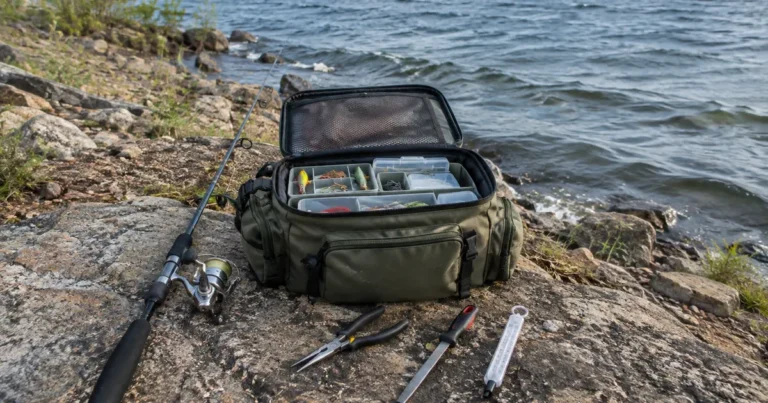
You don’t need a big box to cover all three. A bank angler’s kit fits in one bag:
- A spinnerbait to search. It covers water fast and comes through grass and wood.
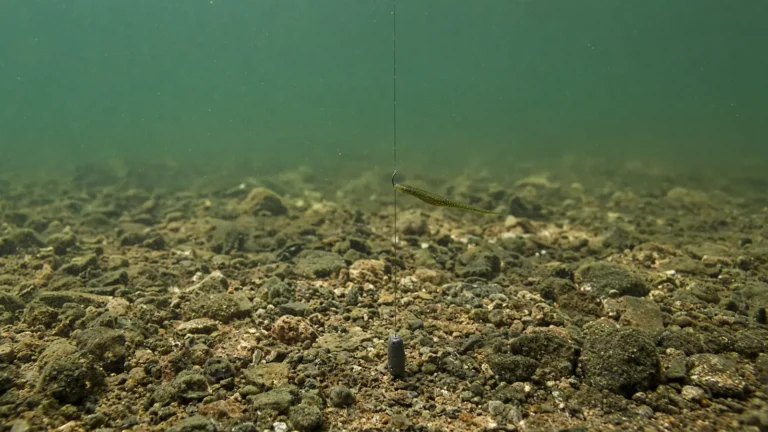
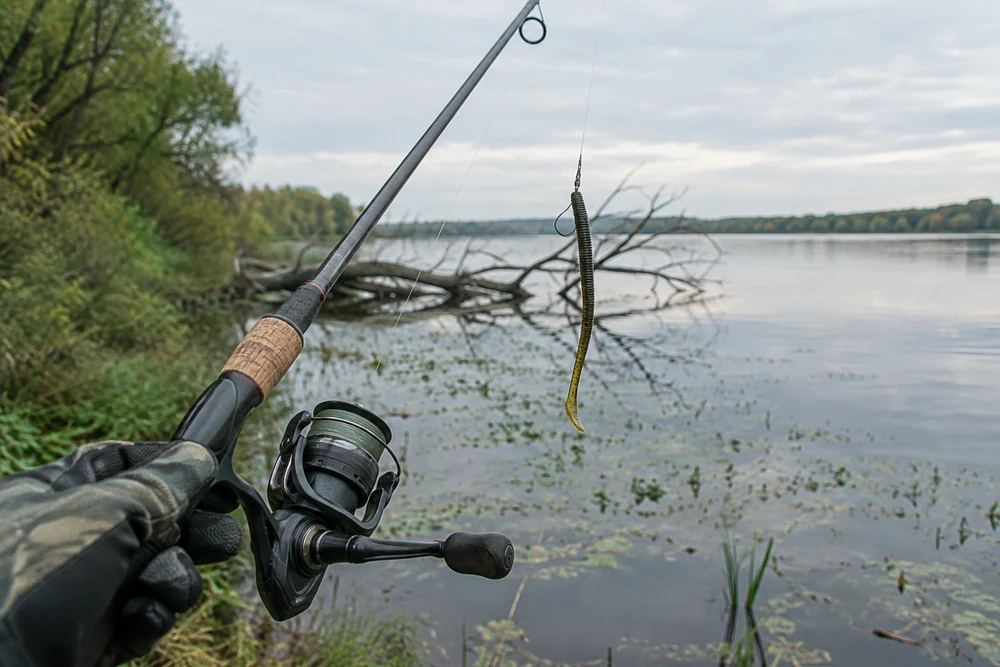
- Texas-rigged soft plastics, a worm and a craw, to slow down and pick apart whatever the spinnerbait finds. If you’ve never tied one, here’s how to rig and fish a Texas rig.
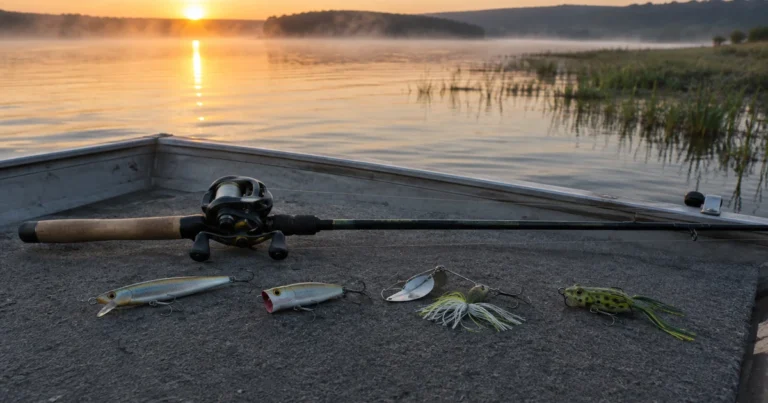
- One topwater for dawn, dusk and fish busting bait on the surface.
Bottom, cover, mid-depth and surface: those three lures answer all of it.
Fish Each Spot, Then Turn One Bass Into a Pattern
- Cast past the target. Land the lure 6 to 10 feet beyond the stump or dock corner, so it swims by the fish the way real food arrives.
- Make the first cast your best one. It’s the only cast the fish haven’t been warned about.
- Give each spot 3 to 5 good casts, then move. An active bass usually hits early. Try one more angle, then go, unless you know for sure fish are there.
Your first fish of the day is information. Before you cast again, note four things: depth, type of cover, lure and retrieve, and time of day. Then go straight to the nearest spot that matches and run the same presentation. If a second bass bites, you have a pattern. Bass in one lake react to the same conditions in the same way, so a pattern can turn a 2 or 3 fish day into a 10 to 20 fish day.
New to all of this? Don’t try to learn it at once. Build it in layers over about ten trips: one rig until you can feel the bottom, then a search lure, then a dawn topwater, then reading the water before your first cast, and finally patterns.
Five Quiet Reasons You’re Not Getting Bit
- You’re fishing the date. “It’s October, so it’s fall” doesn’t hold if your water still reads 84°F. Trust the thermometer.
- You’re fishing your memories. Last year’s hot spot isn’t automatically today’s. At every stop, ask yourself whether you’d fish it if you had never caught a bass there.
- Your line is the wrong type for the job. No-stretch braid tears treble hooks free, and sinking fluorocarbon drags a topwater down. Match the line to the technique before you worry about visibility.
- Your lure is bigger than the bait. In early fall the young shad are only 2 to 3 inches long. Swipes and short strikes mean it’s time to downsize, not to change spots.
- Your treble hooks are in the thick stuff. Trebles in matted grass and laydowns just hang up. Use single hooks in heavy cover and save trebles for open water.
Frequently Asked Questions
How deep should I fish for bass?
It depends on the water temperature. In winter, bass school on the deepest stable structure, often 20 to 40 feet on Southern reservoirs. Before the spawn they stage around 8 to 15 feet, they nest in 1 to 6 feet during the spawn, and in summer they feed shallow early and late, then drop to 15 to 25 feet at midday.
What weather is best for bass fishing?
Overcast days and light rain are excellent, because bass stay active all day. The 12 to 36 hours before a storm system arrives, while the barometer falls, are often the best of the week. The day after a cold front is the hardest, and a thunderstorm means you get off the water.
Why am I not catching bass where I used to?
Bass in a lake tend to move together when conditions change, so they haven’t vanished, they’ve relocated. Check the water temperature, think about where the fish would logically go next, and fish the structure in front of you instead of the spot you remember.
Is catching largemouth different from smallmouth?
The four decisions are the same, but the answers change. Largemouth like warm, weedy, still or slow water and eat almost anything. Smallmouth prefer clear, cool, rocky water, lean heavily on crawfish and are more selective.
Tight lines,
— David