Ask anglers what makes walleye hard and you’ll hear: “They’re moody. They disappear. They only bite at night. You need a fancy boat.” All four answers come from the same mistake: treating walleye like bass.
A bass is an ambush predator that relates to cover. A walleye is a roaming, light-sensitive, schooling predator that relates to structure, depth and food. And walleye are predictable. Three things decide where they are: light, water temperature and forage. All three can be read before you leave the driveway.
On this page
- The Walleye’s Eyes Explain Almost Everything
- Walleye, Sauger or Saugeye?
- How Walleye Bite
- Where Walleye Live: On the Edges
- The Walleye Year: Fish the Thermometer
- Techniques That Catch Walleye
- The Night Bite
- No Boat? Shore Anglers Get the Best Windows
- On the Ice
- Four Mistakes That Cost You Walleye
- Frequently Asked Questions
The Walleye’s Eyes Explain Almost Everything
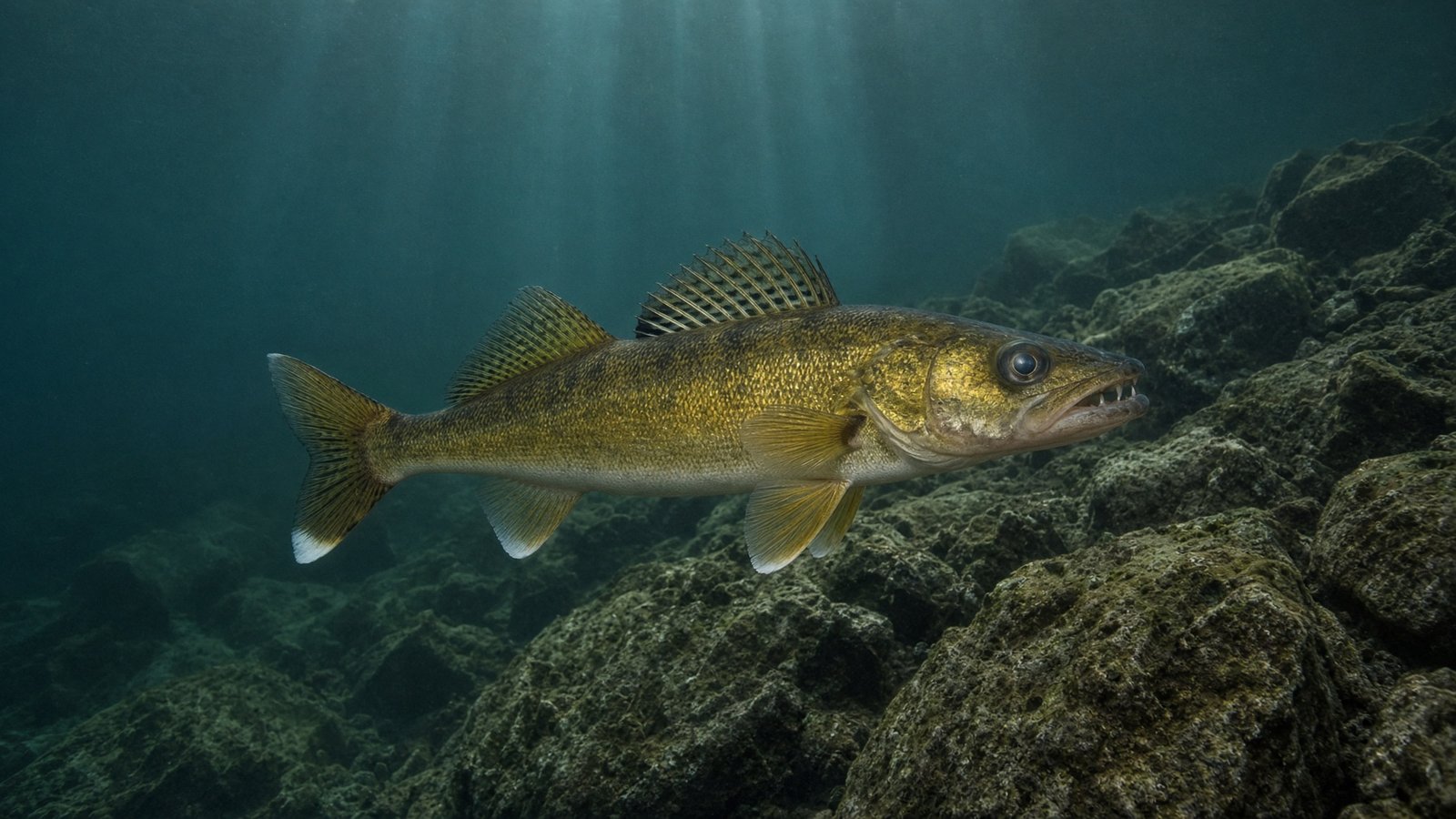
Walleye are named for their large eyes, covered with a reflective layer called the tapetum lucidum. It lets them see well in light levels where their prey is nearly blind. It also makes bright light uncomfortable for them.
- Walleye feed hardest when light is low or broken: dawn, dusk, night, deep water, stained water, wind-churned water, heavy clouds.
- In clear water under high sun, they slide deeper, tuck into shade or bury in weeds. They aren’t gone. They moved to comfortable light.
- The prime windows are roughly the 90 minutes around sunrise and the two hours around sunset, extending into full night on clear water.
A cloudy, windy Tuesday at noon can outfish a calm, sunny Saturday dawn. Read the light, not the clock.
Walleye, Sauger or Saugeye?
A walleye has a white patch on the lower tail lobe and no spots on the dorsal fin. A sauger has no white tail patch and rows of distinct black spots on the dorsal fin, and it rarely tops 4 lbs. Saugeye, a hybrid stocked in many Midwest reservoirs, shows both spots and blotches and behaves like an aggressive walleye. In rivers, if you only catch sauger, move shallower or to slacker current to find the walleye.
How Walleye Bite
- The pin-and-turn: the classic. A walleye inhales the bait and turns away. You feel a soft tick, a little extra weight, or see the line move sideways. Anything different is a fish, so set on suspicion.
- The follow-and-nip: common in cold water and behind trolled baits. The fish nips the tail. That’s what stinger hooks are for.
- The reaction strike: in low light, warm water or wind, walleye run down and crush a fast crankbait or blade bait.
Fish fast to find the aggressive fish, then slow down when the fish tell you to.
Where Walleye Live: On the Edges
Walleye live on the edges of things: shallow and deep, rock and sand, weeds and open water, current and slack, light and dark.
The breakline
A breakline is where the bottom drops quickly from a flat into deeper water. Walleye rest along its base by day and slide up to its lip to feed in low light. Follow one depth contour instead of the shoreline, and fish the irregularities: points, inside turns and fingers where the contour lines pinch together. The daily rhythm: shallow lip at dawn, mid-slope in the morning, base at midday, back up in the evening, on top of the flat after dark.
The big five structures
- Points that extend underwater: every depth in one spot. Fish the tip and both inside corners.
- Humps topping at 5 to 20 feet surrounded by deep water: summer and winter magnets.
- Sand and gravel flats: feeding tables, best with wind or low light.
- Weedlines: the deep edge where weeds stop growing, a season-long walleye home that most anglers leave to bass fishermen.
- Saddles: the dip between two humps, or a hump and shore. Fish funnel through them.
Rock and wind
Rock holds the whole walleye life cycle, and rock touching a breakline beats the same rock on a flat. Wind is the walleye angler’s best friend: it cuts light, pushes plankton and baitfish against the downwind shore, and breaks up the surface. A “walleye chop” of 1 to 2 foot waves rolling onto a point or rocky shore can put fish in 2 to 6 feet of water at midday. Fish the windy side.
One more question to ask at every new lake: what do the walleye here eat, and where does that food live this month? Perch lakes put walleye on weedlines and gravel. Shad and shiner systems put them in open water. Cisco and smelt lakes send them deep in summer, and that’s where 10-pounders grow.
The Walleye Year: Fish the Thermometer
- Pre-spawn (34 to 42°F, rising): fish stage near spawning grounds, in the first deep holes below river rapids and dams, and off gravel shorelines. The big females slide shallow in the last two hours of light. Fish slow.
- Spawn (42 to 50°F): rock and gravel in 1 to 6 feet, river rapids and tailraces. Check your regulations, since many waters close during the spawn, and handle big females like glass.
- Post-spawn (50 to 58°F): a tough two weeks. Follow the food into warm, dark-bottom bays and fish shallow flats at dusk and night.
- Early summer (58 to 68°F): the easiest fishing of the year. Weedlines, points, flats and humps in 6 to 15 feet. Leeches become the number one bait once the water crosses about 55°F.
- Summer (68°F and up): fish split into deep structure fish at 15 to 35 feet, suspended fish over open basins, and a night bite in clear lakes. Walleye eat more in summer, not less.
- The fall feed (58°F falling through 42°F): the trophy window. The biggest walleye feed hard and shallow on steep points, river mouths and the last green weeds. Use big baits: 4 to 6 inch chubs or suckers, and bigger stickbaits. Don’t quit in October.
The Walleye Calendar Month by Month
Months follow a typical northern-tier schedule. Shift earlier as you go south and later as you go north: different month, same water temperature.
| Month | What walleye are doing | Where to fish them |
|---|---|---|
| January | Midwinter under the ice | Basin flats at 25 to 40 ft; the 45 minutes around sunset |
| February | Deep winter | Tighter windows, finesse spoons and a deadstick minnow |
| March | Late ice, first open water | Staging below dams and off river mouths |
| April | Pre-spawn and spawn (42 to 50°F) | Rivers and rock shorelines; vertical jigs and dusk stickbaits |
| May | Recovery into early summer | Warm bays, then points and first weedlines |
| June | The easy season (58 to 68°F) | Weedlines, flats and humps; leeches and slip bobbers |
| July | Summer pattern | Deep structure by day, suspended fish over basins, night bite |
| August | Peak summer | Deepest structure; dawn, dusk and night |
| September | Cooling and turnover | Follow the bait shallower; rivers and shallow lakes during turnover |
| October | The trophy month | Big baits on steep structure, river mouths, last green weeds |
| November | Cold-water giants | Slow and big: jumbo chubs, glide baits, dusk windows |
| December | First ice (where safe) | The November spots, fished through the ice |
Want the complete 12-month system? Walleye Fishing Mastery gives you the temperature trigger, the locations and the top presentations for every phase of the year, plus the full night and ice systems.
Techniques That Catch Walleye
1. Jig and minnow
More walleye have been caught on a jig tipped with a minnow than on anything else. Use the lightest jig that keeps bottom contact: 1/16 oz to 10 feet, 1/8 oz to 15 feet, 1/4 oz to 25 feet, and more beyond that or in wind and current. The standard retrieve: lift 6 to 12 inches, lower until the line just goes slack, pause 2 to 3 seconds, repeat. In water under 45°F, holding the jig dead still often beats everything.
2. The slip bobber
Set the bait 6 to 18 inches off bottom (13.5 to 14.5 feet over a 15-foot rock pile), anchor upwind, and let the waves walk the float across the spot. A leech under a slip bobber on a rock point at dusk is one of the highest-percentage big-walleye presentations there is.
3. Live bait rigs
A Lindy rig (sliding sinker, swivel, 3 to 8 foot snell, single hook) moved at 0.3 to 0.8 mph lets a walleye take the bait without feeling the weight. From June through September, a bottom bouncer and crawler harness at about 1.0 mph along a breakline is the most reliable “I need to catch walleye today” technique. Bouncer weight: 1 oz per 10 feet of depth.
4. Trolling at the right speed
Speed depends on water temperature. Crankbaits: 1.0 to 1.5 mph under 50°F, 1.5 to 2.0 mph from 50 to 65°F, 2.0 to 2.8 mph above 65°F. Walleye feed upward, so run your baits just above the fish, never below them.
5. The stinger hook
When fish nip tails and you miss every hit, add a small #10 treble on a short loop from the jig’s eye, one point lightly pinned near the minnow’s tail. It converts short strikers like nothing else.
The Night Bite
On clear lakes, from spring through ice-up, walleye push shallow after dark: 2 to 10 feet over rock points, gravel shorelines, riprap and harbor mouths. The fish under the boat at 22 feet in the afternoon is cruising a 5-foot boulder flat at 10 PM. Cast a slender #8 to #12 minnow stickbait with a slow, straight retrieve and a few 2-second pauses. Stay quiet, use a red light only, and learn the water in daylight first.
No Boat? Shore Anglers Get the Best Windows
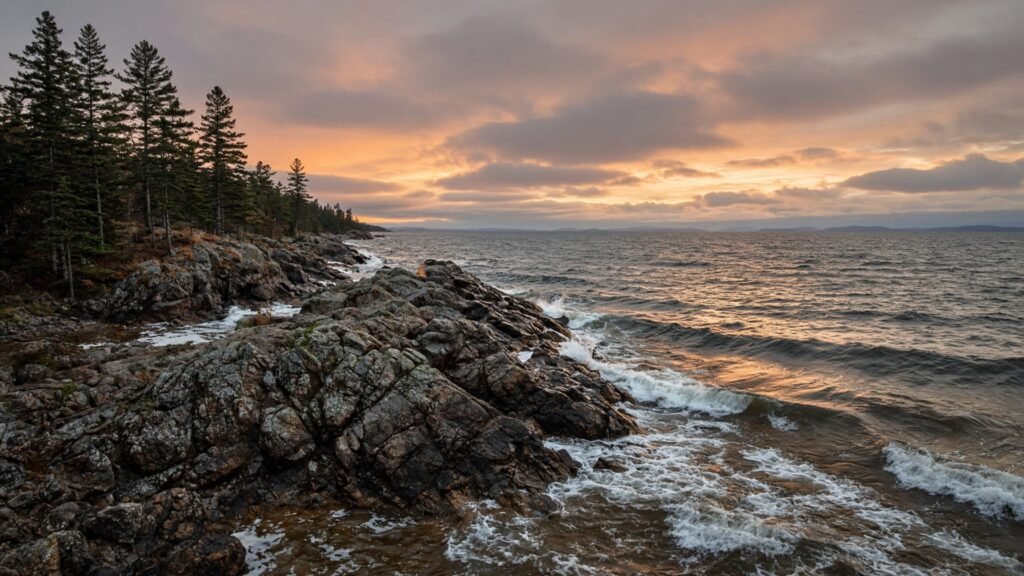
Walleye spend a remarkable share of the year within casting distance of land. Spring brings fish below dams, along river walls, on riprap and gravel shorelines. Fall nights on riprap, piers and rocky points produce real trophies for anglers standing on shore. Carry three rods where legal: a stickbait to search, a slip bobber with a leech or minnow to soak, and a jig for current seams. Stand back from the edge in clear water and cast parallel to the bank.
On the Ice
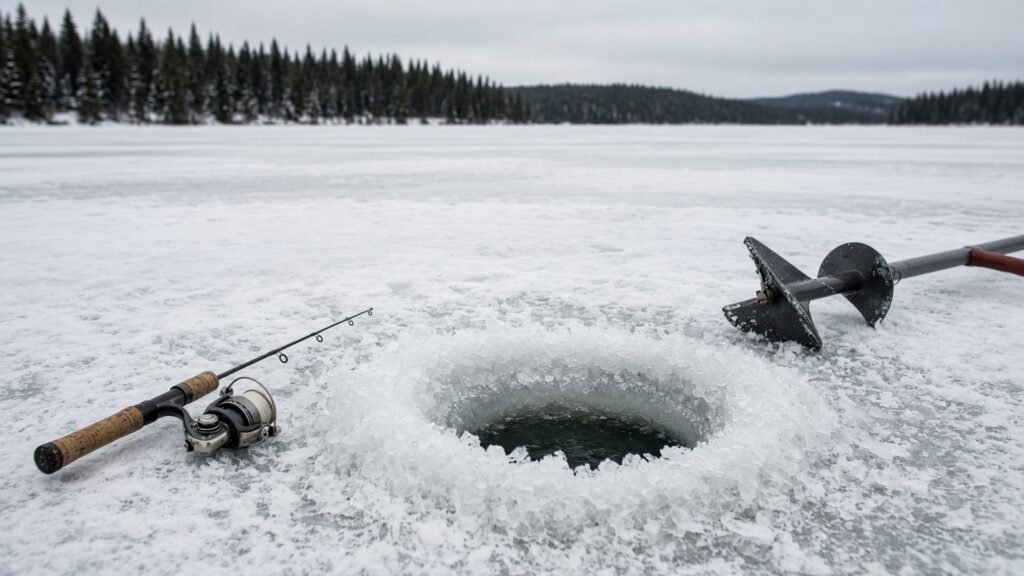
Winter walleye feed hardest in a short window: from about 30 minutes before sunset to 30 to 45 minutes after dark. Drill your holes by mid-afternoon, then be jigging quietly 90 minutes before sunset. Safety first: 4 inches of clear, new ice is the minimum for walking, carry ice picks around your neck and a throw rope, and never trust ice you haven’t checked yourself.
Four Mistakes That Cost You Walleye
- Fishing bass hours. If you only have four hours, make them the last four hours of light.
- Jigging too heavy. Use the lightest weight that keeps contact. If you never lose touch with the bottom, you’re too heavy.
- Waiting to feel a thump. Half of walleye bites are a tick, a weight or a line twitch. Set on anything different.
- Hiding from the wind. The calm side is comfortable because nothing is happening there.
When nothing works, change things in this order: depth first, then location, then speed, then size, and color last.
Frequently Asked Questions
What time of day is best for walleye?
Two hours before sunset until about an hour after dark is the best window on most waters, with dawn a close second. Walleye feed when light is low or broken, so cloud cover, wind or stained water can turn the middle of the day on too.
What depth are walleye at?
It follows the water temperature. They’re shallow, about 2 to 10 feet, in spring, fall and at night; in the 6 to 15 foot food zones in early summer; and on 15 to 35 foot structure at the peak of summer. They also run shallower than normal when it’s windy, cloudy or dark.
What is the best bait for walleye?
A jig tipped with a minnow is the all-around answer. A leech under a slip bobber owns summer evenings, and a slender stickbait retrieved slowly over shallow rock after dark catches some of the biggest walleye of the year.
How fast should you troll for walleye?
Go by water temperature: about 1.0 to 1.5 mph under 50°F, 1.5 to 2.0 mph from 50 to 65°F, and 2.0 to 2.8 mph above 65°F for crankbaits. Crawler harnesses run slower, roughly 0.6 to 1.5 mph.
What size jig should you use for walleye?
Use the lightest jig that keeps bottom contact: about 1/16 oz down to 10 feet, 1/8 oz to 15 feet, 1/4 oz to 25 feet, and 3/8 oz or more beyond that or in wind and current.
When is the best time to catch a big walleye?
The fall feed, from the time the water falls through the mid-50s until ice-up, especially late October and November. First ice, the pre-spawn period and night fishing on clear water are the other big-fish windows.
More Walleye Fishing Guides
- Jig and Minnow for Walleye: The Complete How-To
- Night Walleye Fishing From Shore: The Complete System
- Fall Walleye Fishing: The Trophy Window
Go Deeper: Walleye Fishing Mastery
This page is the map. Walleye Fishing Mastery is the full territory: walleye biology and senses, the three-rod gear system, the complete presentation encyclopedia, reading walleye water, eight techniques step by step, the 12-month system, the walleye clock and night system, ice fishing, river walleye, the trophy blueprint, the no-boat system, the 10 deadliest mistakes and a 15-situation playbook.
It’s an instant PDF download that works on phone, tablet and computer. Nothing ships, it’s yours to keep, and every future update is free.
Tight lines,
— David