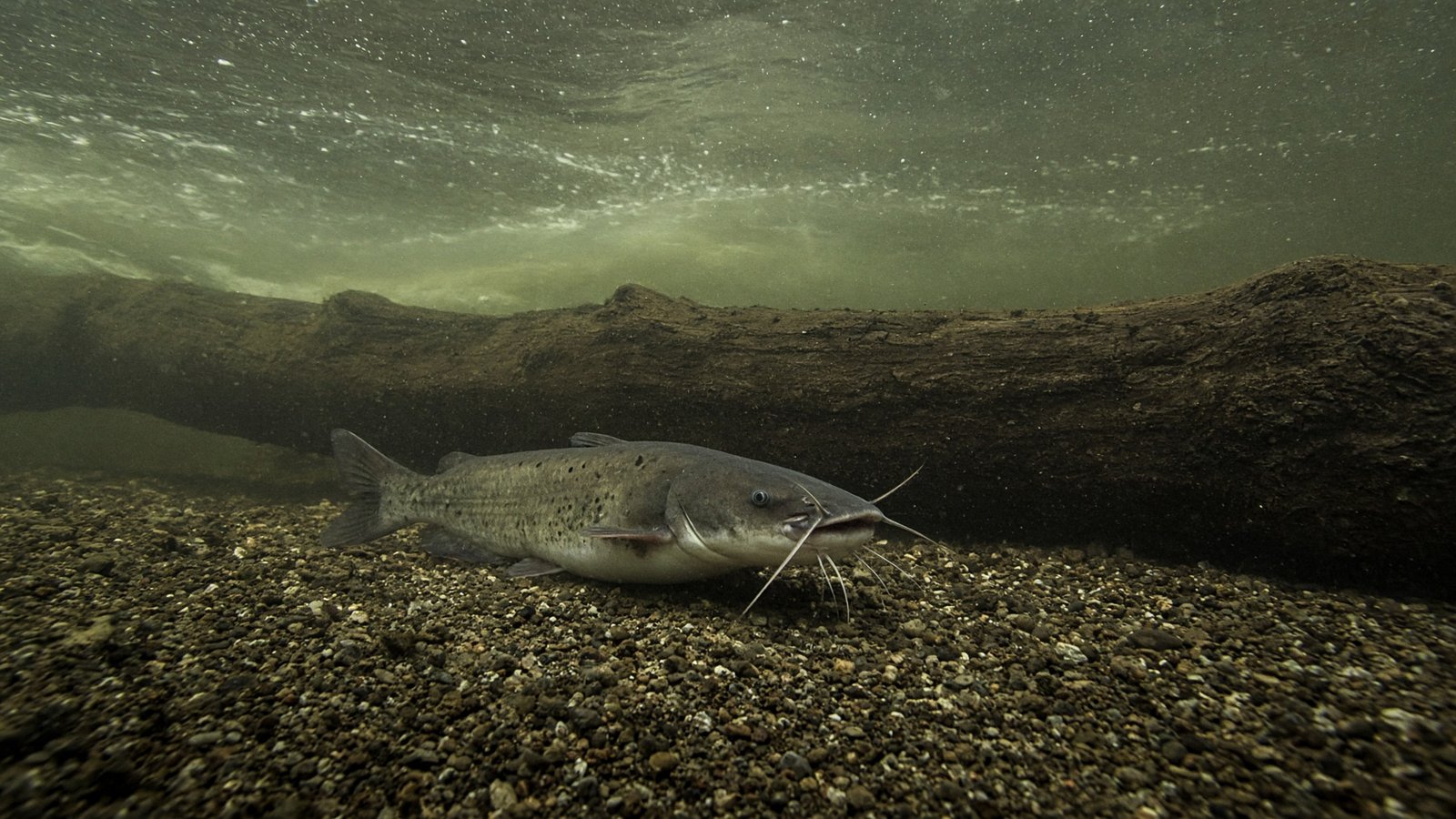
Most people who fish for catfish are doing it wrong without knowing it. They use the wrong bait for the species they’re after, fish the right spot at the wrong depth, or use a hook too dull to penetrate. Then they blame bad luck.
Catfish aren’t picky the way bass can be, but they are very sensitive to scent, presentation, water conditions and timing. Once you understand a handful of principles, catfishing becomes one of the most consistent kinds of fishing there is. You don’t need a $400 rod, you don’t need a boat, and some of the “worst” weather for other species is prime time for catfish.
On this page
- Know Your Catfish: The Species Decides Everything
- How Catfish Find Food: Scent First
- Where Catfish Hold: Structure and Current Breaks
- The Catfish Year: Follow the Water Temperature
- Bait: Match It to the Species
- Rigs and Hooks: Keep It Simple
- Timing and Weather
- No Boat? The Bank Is Enough
- Five Mistakes That Cost You Catfish
- Frequently Asked Questions
Know Your Catfish: The Species Decides Everything
The species you’re after sets your bait, your gear, your spot and even your hours.
- Channel catfish: the most widespread and the best place to start. Deeply forked tail, scattered dark spots, rounded anal fin. Usually 2 to 15 lbs. The most scent-driven species, active day and night, and willing to eat cut bait, stink bait, liver and worms.
- Blue catfish: the heavyweight. No spots and a straight-edged anal fin (the easiest way to tell a blue from a channel). Fish of 20 to 50 lbs are common in good water. Blues follow shad schools, sit in current other species avoid, and live in big rivers, reservoirs and tailwaters.
- Flathead catfish: the predator. Broad flat head, protruding lower jaw, square tail. Solitary, territorial, heavily nocturnal, and almost exclusively a live-bait eater. If you’re soaking stink bait and never catch flatheads, this is why.
- Bullheads: small, rounded tail, found in ponds and slow creeks. They bite almost anything, which makes them perfect for kids and beginners.
How Catfish Find Food: Scent First
Catfish see poorly, especially in murky water or low light. To make up for it, they are covered in taste buds: more than 100,000 across the skin, fins and barbels. A catfish literally tastes the water it swims through. That changes how you fish:
- Scent beats looks. A plain bait that releases a strong, steady scent trail outfishes a pretty bait with little odor.
- Current is your delivery system. In moving water, your scent trail spreads downstream in a cone that fish follow up to your bait.
- Low light turns them on. Dawn, dusk, overcast days and night bring more confident feeding. Bright sun pushes them deeper or tighter to cover. In stained or muddy water, the day and night difference shrinks.
Catfish are most active when the water sits between 70 and 85°F. Below 50°F, feeding slows dramatically.
Where Catfish Hold: Structure and Current Breaks
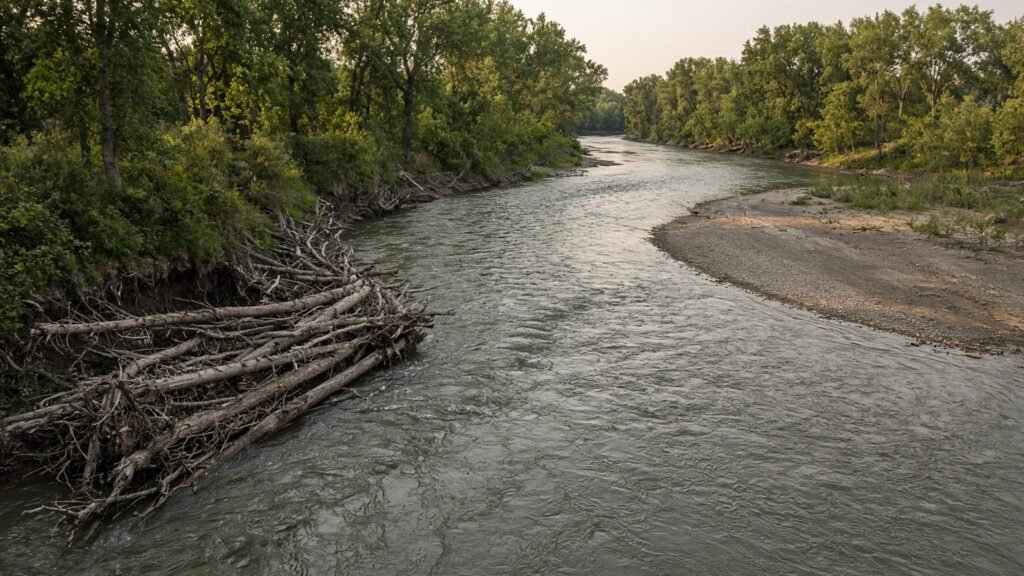
Catfish aren’t built for long, fast swimming. They save energy in spots where the current is slower but food still drifts past. Find where those two things meet.
On rivers: five spots that hold catfish
- Current breaks behind structure: a downed tree, a bridge piling or a boulder creates a slow pocket downstream. Catfish hold there facing the current.
- Deep holes: the outside of a river bend scours out the deepest water, with stable temperature and slower current near the bottom.
- Confluences: where a creek enters the main river, the mixing currents concentrate food.
- Eddies: the slow, circular current behind a point or obstruction traps drifting bait.
- Tailwaters below dams: turbulence disorients baitfish and draws blue catfish, often the biggest fish in the system.
On a river you’ve never fished, start at a confluence or a visible current break near a deep bend.
On lakes and reservoirs: think in layers
Spring: shallow flats near spawning coves and rocky banks, 3 to 10 feet. Summer: humps, channel ledges and deep brush, 15 to 30 feet or more. Fall: points and secondary creek channels at mid-depth. Winter: the deepest water available, main channels and deep holes near the dam. In reservoirs, the old flooded creek channels are catfish highways, especially for blues.
In ponds
Fish the deepest part (often near the dam), any visible structure, and inflow pipes or ditches where food washes in. Early morning and evening produce best.
The Catfish Year: Follow the Water Temperature
- Spring (55 to 70°F): fish move toward shallow flats and coves. Target staging areas just outside the flats early, then move shallower as the water warms. During the spawn itself (high 60s to low 70s), the bite can slow for a while. That’s normal.
- Summer (70 to 85°F): the most consistent catfishing of the year, but the action shifts to evening, night and early morning. Deep structure by day, flats and current breaks as it cools. Prime season for stink and dough baits.
- Fall (falling from 70 to 50°F): an active feeding period before winter, and an underrated window for trophy blue catfish keyed on dense shad schools. Cut bait shines.
- Winter (below 50°F): deep, stable water and patient fishing. Fresh cut bait outperforms stink bait in cold water. Bites are fewer, but often from bigger fish.
The Catfish Calendar Month by Month
A reference for a temperate US climate. The same month can fall in a different season where you live, so go by water temperature first.
| Month | Typical pattern | Where to focus |
|---|---|---|
| January | Deep winter holding | Deepest available water, slow and patient fishing |
| February | Late winter, first warming | Deep holes; watch for the first warm-water pulses |
| March | Pre-spawn staging begins | Staging areas just outside shallow flats |
| April | Active pre-spawn feeding | Shallow flats, coves, current breaks |
| May | Spawn (varies by latitude) | Cavity structure; expect a short feeding lull |
| June | Post-spawn recovery | Transitional depths, more low-light activity |
| July | Peak summer | Deep by day, shallow and active at dusk and night |
| August | Late summer heat | Deepest shaded structure by day; night fishing is prime |
| September | Early fall transition | Points and secondary channels |
| October | Fall feeding window | Strong cut bait bite; an underrated trophy blue month |
| November | Late fall cooldown | Moving toward winter holding areas |
| December | Early winter | Main channel and deep holes, slower presentations |
Want the month-by-month plan? Catfish Fishing Mastery includes a full 12-month calendar, the five rigs that cover almost every situation, and three homemade stink bait recipes.
Bait: Match It to the Species
- Cut bait: the most reliable bait for channel and blue catfish. Shad and skipjack herring are premium; carp and suckers work too where legal. Cut small channel cat baits into 1 to 2 inch chunks with skin on, and use 2 to 4 inch chunks or a whole small baitfish for big channels and blues. Cut at an angle and slit the skin to release more scent.
- Live bait: close to mandatory for flatheads. Live bluegill (where legal), shiners and crawfish. Hook baitfish through the lips or below the dorsal fin, crawfish through the tail, and keep them lively.
- Stink and dough bait: the channel cat specialist’s weapon, best in warm (75°F and up), still or slow water. Blues and flatheads respond inconsistently.
- Chicken liver: a cheap, excellent channel cat bait. It’s soft, so wrap it in thread or a piece of pantyhose to keep it on the hook.
For trophy fish, use one large, quality bait instead of several small ones. Big fish won’t waste energy on a snack.
Rigs and Hooks: Keep It Simple
The slip sinker rig: your default
Thread a 1 to 3 oz sliding sinker on your main line, tie a barrel swivel below it, add a 12 to 24 inch leader and a circle hook. The sinker slides, so a fish can pick up the bait and move without feeling the weight. When in doubt, tie this one.
The three-way rig for strong current
Main line to a three-way swivel, a short dropper of slightly lighter line to the sinker, and an 18 to 24 inch leader to the hook. It holds bottom in fast water, and if the sinker snags, the lighter dropper breaks first and saves the rig.
Circle hooks: don’t set the hook
Circle hooks slide into the corner of the mouth on their own as the line comes tight, which cuts gut-hooking. The one rule: when the rod loads up, reel steadily into the fish. Yanking pulls the hook out before it can turn. Size up rather than down, and test sharpness on your thumbnail before every trip.
Timing and Weather
- Falling pressure 6 to 24 hours before a front often triggers a strong feed.
- Rapidly rising pressure right after a front brings the slowest fishing. Activity usually rebounds in 24 to 48 hours.
- Light to moderate rain and runoff often help: they wash food in and stain the water. Major flooding is a different story; stay safe.
- Wind blowing into a shallow flat or shoreline for a few hours concentrates bait there.
If you can only control one thing, control the time of day. Dawn, dusk or night on good structure beats a perfect pressure window at 2 PM in summer sun almost every time.
No Boat? The Bank Is Enough
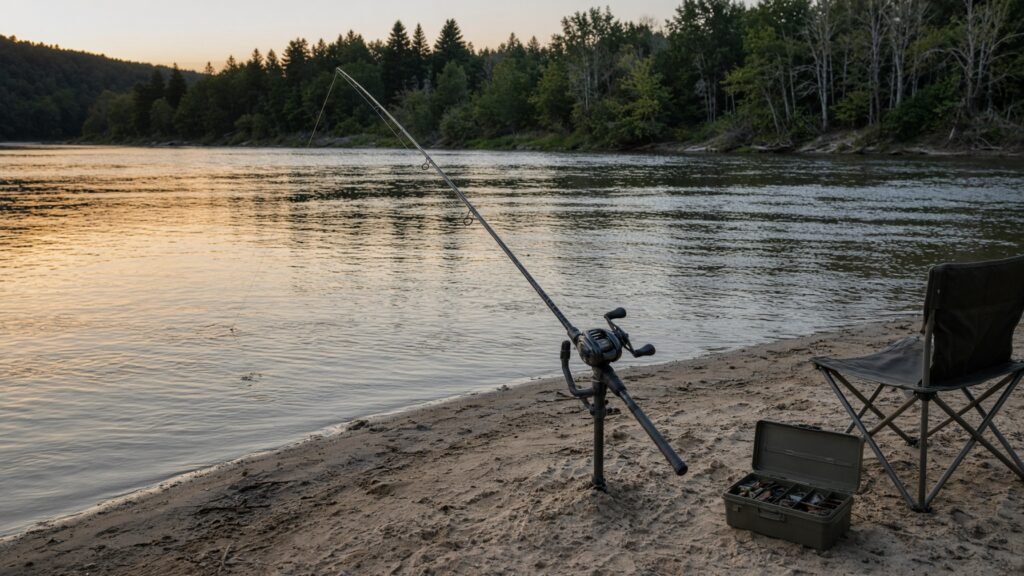
Set 2 to 4 rods in spike holders angled at 30 to 45 degrees, where legal. Cast one close to structure, one to a mid-range drop-off or seam, and one to maximum distance. After 30 to 45 minutes, move your other rods to the depth and distance that’s producing. Light repeated taps mean a fish is testing the bait; wait for the rod to load and stay loaded. At night, when boat traffic and pressure drop off, bank anglers are on equal footing with boats, or better.
Five Mistakes That Cost You Catfish
- The wrong bait for the species. Stink bait won’t catch flatheads. Use live bait for them.
- Pretty spots instead of productive ones. Fish current breaks, confluences, channel edges and depth changes, not the view.
- Dull hooks. Run the thumbnail test before every trip.
- The wrong hookset for your hook. Reel steadily on circle hooks; set firmly on J-hooks.
- Giving up too early. Give a spot with good structure 30 to 45 minutes, longer for flatheads and trophy fish.
Before you fish jugs, limb lines or noodling, check your state’s regulations: those methods are restricted or banned in many places.
Frequently Asked Questions
What is the best bait for catfish?
For channel and blue catfish, fresh cut bait such as shad or skipjack herring on a slip sinker rig is the most versatile choice in nearly all conditions. Flathead catfish are different: they are live-bait predators, so use live baitfish or crawfish.
Do catfish only bite at night?
No. Channel and blue catfish feed during both day and night, though activity often increases after dusk, especially in warm months. Flatheads are the exception and are almost entirely nocturnal.
What is the best rig for catfish?
The slip sinker rig: a sliding sinker on the main line, a barrel swivel, a 12 to 24 inch leader and a circle hook. A fish can pick up the bait and move without feeling the weight. In strong current or on snaggy bottoms, switch to a three-way swivel rig.
How do you set a circle hook on a catfish?
You don’t jerk it. When the rod loads up, reel steadily into the fish and let the hook slide into the corner of the mouth on its own. Yanking back usually pulls a circle hook free before it can rotate into place.
How long should you fish one catfish spot?
Give a spot with good structure 30 to 45 minutes before moving, and longer if you’re targeting flatheads or trophy fish, where patience is part of the strategy.
What water temperature are catfish most active?
Catfish feed most aggressively when the water is 70 to 85°F. Below about 50°F, feeding slows sharply and they hold in deep, stable water, feeding in short windows.
More Catfish Fishing Guides
- The Slip Sinker Rig for Catfish, Step by Step
- The Best Catfish Bait for Each Species
- Where Catfish Hold in a River: 5 Spots to Fish First
Go Deeper: Catfish Fishing Mastery
This page is the map. Catfish Fishing Mastery is the full territory: the complete species guide, the five rigs and four knots that cover over 90% of situations, hook and sinker sizing by species, the ultimate bait guide with homemade stink bait recipes, bank, boat, drift and jug techniques, a 12-month calendar, trophy tactics, landing and handling big fish, and cleaning and cooking your catch.
It’s an instant PDF download that works on phone, tablet and computer. Nothing ships, it’s yours to keep, and every future update is free.
Tight lines,
— David