Bass Fishing in November: Read the Water, Then Pick a Plan
Bass fishing in November comes down to one thing: read the water temperature first, because the same lake fishes like fall at 60°F and like early winter at 52°F, often a few weeks apart. Above 58°F, keep chasing the shad shallow with fast baits. Below it, slow down and follow the bass back toward deeper water. Everything below plugs into our complete bass fishing system, with plans for reservoirs, rivers and the bank.
Bass Fishing Mastery: the complete system this article comes from, as an instant PDF. Get the guide — $17
November Is a Hinge Month
October and December are easy to describe. November is the month in between, and it can swing from one to the other in a single week. In the guide’s month-by-month chart, November covers water from 50°F up to 62°F. The fish are on the move toward deeper water, and the short list of baits for the month is a jig, a Texas rig and a medium-diving crankbait.
That range is wide on purpose. Fall reaches one lake at a time as the nights cool, so a reservoir in the South can still be in October mode while a northern lake is already close to winter. A cheap thermometer, checked at the start of every trip, tells you which November you are fishing. If your water is still well above the low 60s, go back to the phases in fall bass fishing; you are not late, your lake is.
What the Thermometer Tells You
| Water reading | What changes | Main baits | Retrieve |
|---|---|---|---|
| 58°F to 62°F | Shad still in the creek backs; bass feed hard on them | Spinnerbait, swimbait, lipless crankbait, shad colors | Fast, cover water |
| Under 58°F | Bass leave the speed baits alone; bites drop, size goes up | Jig, Texas rig, medium diver | Slower; let baits touch bottom and cover |
| Around 52-55°F | The shad bite shuts off almost overnight | Jig, Texas rig, flat-sided crankbait | Slow: cut 30%, then 30% again |
| Near 50°F and below | Bass settle on deeper, stable structure | Finesse jig, drop shot, blade bait | Very slow; give a bass 10 to 15 seconds to decide |
The suspending jerkbait works across most of this range, but the pause has to grow as the water cools: 3 to 5 seconds between 50°F and 60°F, then 8 to 12 seconds once the water drops below 50°F. The bite comes while the bait hangs still.
Where to Start on a Lake or Reservoir
In October, bass push into the backs of the creeks behind the shad and feed on the flats next to the submerged creek bed. In November they leave by the same roads. Think of these spots as the exit ramps:
- The creek channel itself. Bass use these flooded stream beds to move between shallow feeding water and deeper resting water. Start where last month’s flats meet the channel and work outward, giving extra time to the outside bends.
- Secondary points in the creek arms. They sit right on the route out and get far less pressure than the big main-lake points. If one has cover on it and drops straight into the channel, fish it first.
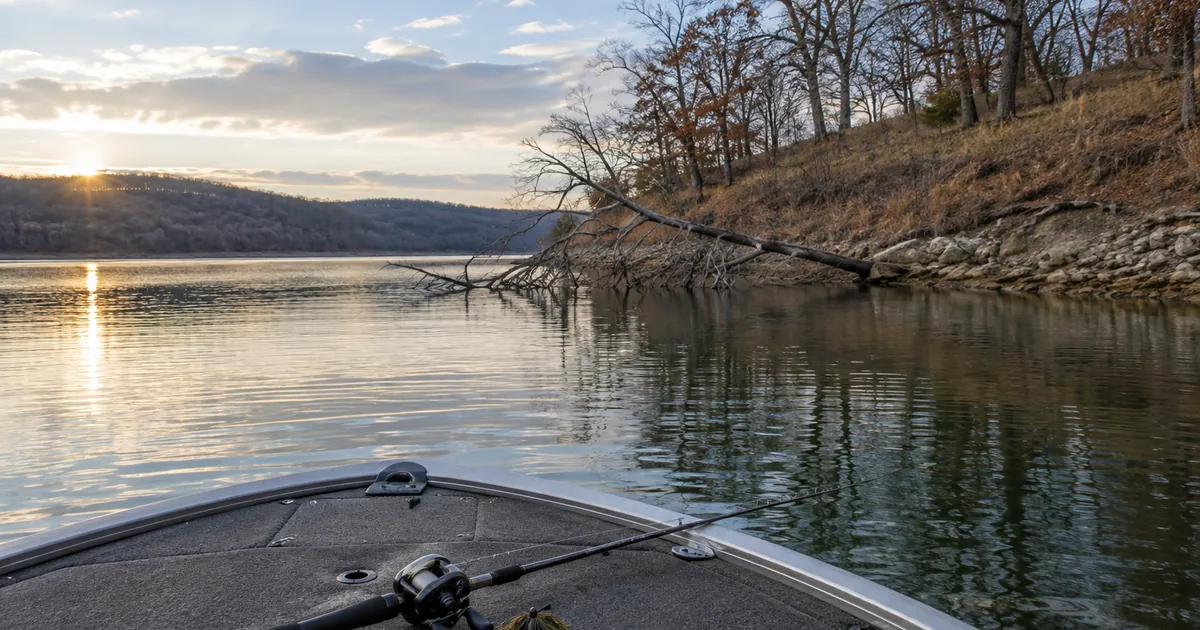
- Wood near deep water. Laydowns and stumps close to the channel gain value as the water chills. Hit the root ball first: it is the deepest, most complex part of the tree.
Two boat positions do most of the work. On a point, sit in deep water off the tip, cast up shallower than you think the fish are, and walk the bait down the slope. On a channel edge, run slowly along it, throw into the deeper side and drag the bait uphill over the edge. With a crankbait, it should touch bottom or cover on each cast; a low, sideways rod angle helps it dig deeper.
Three Kinds of November Day
November is front season, and the weather often matters more than the date. Most days fall into one of three types.
The day before a front
As a storm system approaches and the barometer drops, you often get the best fishing of the week, with the peak 12 to 36 hours before the low arrives. Clouds help too: on an overcast day bass roam the whole water column and a moving bait works from launch to dark. Use moving baits and keep going.
The first real cold snap
A drop of 5°F or more in water temperature can trigger the best bite of the whole year within 24 to 48 hours. The baitfish react before the bass do, bunching up and moving into coves and creek pockets. So hunt bait, not shoreline: diving birds point the way, a shad-shaped bait in white, silver or chrome matches it, and a surface full of dying, flickering shad means you stay all day. That window closes within days.
The bluebird day after
Rising pressure and a clear sky push bass tight to cover and shrink the strike zone. They have not left. Slow down by half, size down by one, and put the bait in the thickest or shadiest part of the best cover. The full post-front routine is in bass fishing after a cold front.
Worked example: a 56°F reservoir two days after a front
Say it is the second week of November. A cold front came through two days ago, the sky is clear, the wind is light, and your thermometer reads 56°F at the ramp. Here is how the plan above sorts out that morning:
- Which November is it? Below 58°F, so the speed baits stay in the box. The main rod gets a jig or a Texas rig; the second rod gets a medium-diving crankbait for the 6 to 12 foot range.
- Which spot first? A secondary point inside a creek arm, with a laydown on it, that falls off into the old creek channel. That is three advantages stacked on one spot.
- Where does the boat go? Out in deep water off the tip of the point. Cast up onto the shallow end, then let each retrieve work a little deeper down the slope.
- How slow? It is a post-front day, so cut the speed in half and drop one size: a finesse jig of 1/8 to 1/4 oz with a small 3-inch craw trailer, put right against the shady side of the laydown.
- Backup bait: a suspending jerkbait. At 56°F, the pause between jerks runs 3 to 5 seconds.
- After the first bite: note how deep it was, what it sat on, the bait and the speed. Then skip the random banks and run every other point in the lake that matches.
Expect fewer bites than in October. The fish that do eat on a day like this tend to be the better ones.
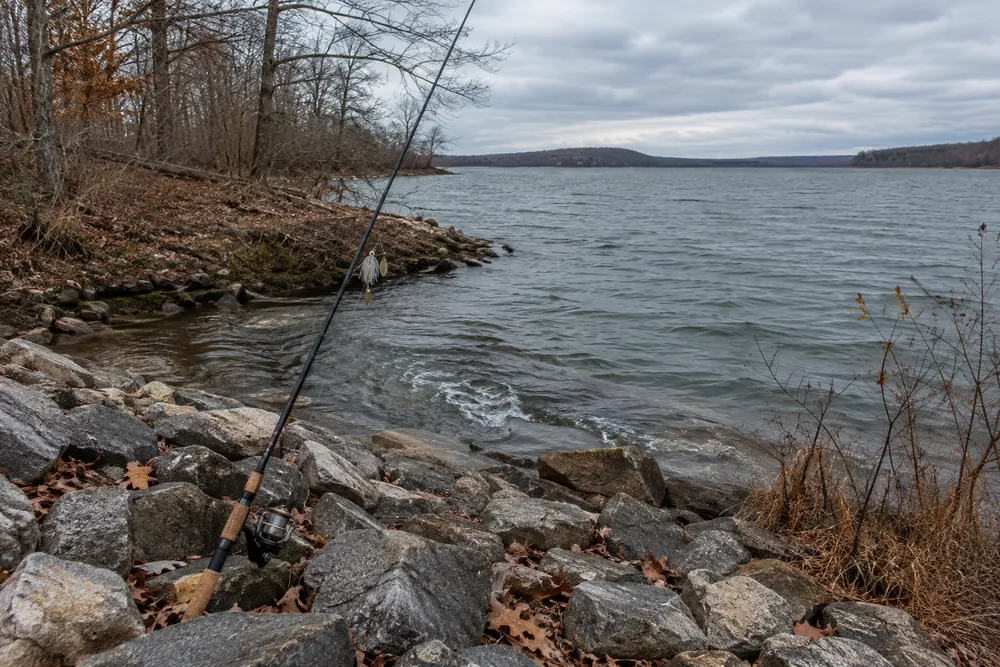
Bass Fishing in November on a River
Rivers run on the same temperatures, with current added on top. In fall, baitfish gang up and migrate, and bass feed hard ahead of winter. That makes creek mouths, and the first pools of the tributaries as bait slides in, the best spots on the river for weeks.
- Fish the confluence as a system: the seam where the two flows meet first, the slow eddy pockets beside it second, then the first deep pool up the creek.
- Approach from downstream and cast upstream of the target, so the current carries the bait into the fish the way real food arrives.
- Watch the gauge as well as the thermometer. Rising water pushes bass shallow and toward the banks; falling water pulls them back toward the channel.
- Late in the month, start checking the wintering holes: the slowest, deepest water, such as outside-bend holes and big eddies.
From the Bank: Your Best Stretch of the Year
September through November is the bank angler’s payday. Bait pushes toward shore, bass follow it into casting range, and the pleasure boats that churned the shallows all summer are gone. Keep the kit light: a spinnerbait to search, a Texas-rigged worm or craw to slow down and pick cover apart, and one topwater for low light.
- Spend ten minutes on a satellite map and pick three to five reachable spots: points, creek and drainage mouths, riprap, the dam face.
- Do not skip the boat ramp. It sits on hard bottom with deep water close by, and most anglers launch there and leave without a cast.
- Pick the bank the wind has been hitting. It has been collecting food all day.
- Give each spot about 15 minutes with the search bait, and slow down only where something answers.
The November Clock
A bass’s eyes work best in low light, which is why the first part of November feeds best early, late and on gray days. Stay on the water until dark: the final half hour of light is a regular feeding window that many anglers spend loading the truck.
As the water slides toward winter, the clock flips. In cold water, the best stretch is usually noon to 4 PM, after a few hours of sun have taken the chill off the top layer. Late in the month, on a cold bluebird day, a slow start and a long afternoon beat a dawn launch.
When November Turns Into Winter
When the thermometer reads somewhere under 52-55°F, the shad bite is done. Bass move onto steady, deeper structure: channel bends, deep points and steep banks. Now a drop shot, a blade bait or a finesse jig earns the casts, and everything slows down again. Whatever speed feels slow, halve it. That side of the season is covered in winter bass fishing.
The Short Version
Take the water temperature, decide which side of 58°F you are on, start where the fall flats meet the creek channel, match your speed to the weather, and stay through the last half hour of light. That simple plan covers most days of bass fishing in November.
Frequently Asked Questions
Do bass still bite in November?
Yes. Typical November water runs from about 50°F to 62°F, and bass are still feeding as they move deeper. A first cold snap that knocks 5 degrees or more off the water often sets off one of the best bites of the year within a day or two.
What lures should you use for bass in November?
A jig, a Texas rig and a medium-diving crankbait cover most of the month. Add a flat-sided crankbait and a suspending jerkbait as the water cools, and during the first mild weeks, when shad are still on the flats, give a spinnerbait or lipless crankbait a spot too. Stick to shad colors.
What time of day is best for bass in November?
In the first half of the month, low light wins: dawn, dusk and cloudy days, plus the last 30 minutes before dark. As the water gets cold, the best window moves toward midday and early afternoon, roughly noon to 4 PM.
Can you catch bass from the bank in November?
Yes, and it is one of the better months for it. Baitfish hold near the shoreline and the summer crowds have left the lake. Walk a short loop of points, creek mouths, riprap and the ramp area, and fish the bank the wind has been hitting.
Tight lines,
— David