How to Catch Catfish: A Simple System That Works
Here’s the short answer on how to catch catfish: tie a slip sinker rig, bait it with fresh cut bait, cast it to a current break, and fish it at dusk. That four-part combination beats what the average weekend angler catches in a full season. Below, each piece is broken down from our complete catfish fishing system, so you can put it to work on your next trip.
Catfish Fishing Mastery: the complete system this article comes from, as an instant PDF. Get the guide — $17
Step 1: Know Which Catfish Live in Your Water
The species decides your bait, your gear, your spot and even your hours. Get this wrong and a perfect rig still catches nothing.
| Species | Typical size | Best bait | When it feeds |
|---|---|---|---|
| Channel cat | 2 to 15 lbs | Cut bait, stink bait | Day and night, more after dusk |
| Blue cat | 20 to 50+ lbs | Fresh-cut shad | Day and night, follows current and shad |
| Flathead | 5 to 30 lbs | Live bait only | Almost entirely at night |
| Bullhead | 0.5 to 2 lbs | Worms, stink bait | Day and night |
If you’re starting out, aim for channel cats. They’re abundant, aggressive, take a wide range of baits, and don’t need heavy tackle. In small, still water with no current, bullheads are probably your main target, and they respond to the same baits scaled down.
Before you go, look up your lake or river on your state wildlife agency’s website. Most publish species surveys by water body. Five minutes there keeps you from packing the wrong bait.
Step 2: Fish for Their Nose, Not Their Eyes
Catfish see poorly, especially in murky water or low light. They make up for it with taste buds all over the body, more than 100,000 of them, packed thickest on the barbels. A catfish tastes the water it swims through. Three things follow from that:
- Scent beats looks. An ugly bait that pumps out a steady scent trail will outfish a pretty bait with little smell.
- Current delivers your scent. In moving water, the scent spreads downstream in a cone, and fish follow it up to your hook. Where you sit relative to the current matters.
- Expect light taps first. Catfish use their barbels to check a bait before they commit. A few soft taps often come before the real bite.
Catfish also feel vibration through the lateral line. You don’t need to fish in silence, since they tolerate noise far better than bass, but stomping on a dock, splashing a heavy sinker down, or dragging your rig through the same water over and over can put them on alert.
Step 3: Cast to a Current Break
Catfish aren’t built to fight current all day. They save energy where the water slows down but food still gets carried past. Find where those two overlap and you’ve found catfish. In a river, check these first:
- Current breaks behind structure: the slow pocket just downstream of a downed tree, bridge piling or big boulder.
- Deep holes on the outside of bends, especially by day and in cold water.
- Confluences, where a creek meets the main river and the mixing water concentrates food.
- Eddies behind points, where drifting food gets trapped.
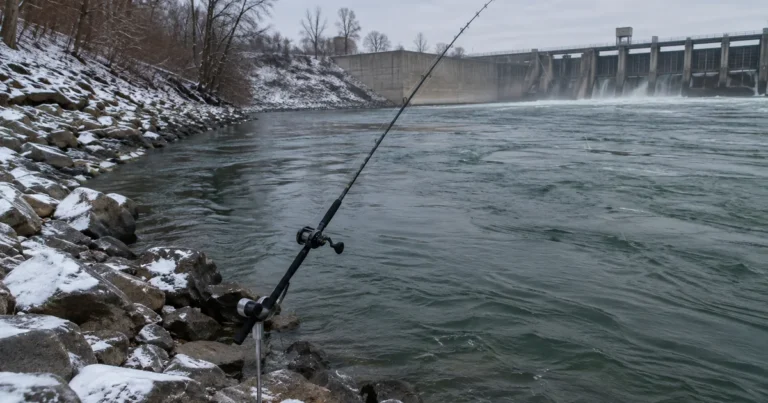
- Tailwaters below dams, a prime spot for blues.
On a river you’ve never fished, start at a confluence or at a visible current break near a deep bend. For a closer look at each one, see our guide to where catfish hold in a river.
In a pond, the same idea applies without the current: fish the deepest part (often near the dam), any dock, fallen tree or weed edge, and any pipe or ditch that feeds water in.
Step 4: Tie the Slip Sinker Rig
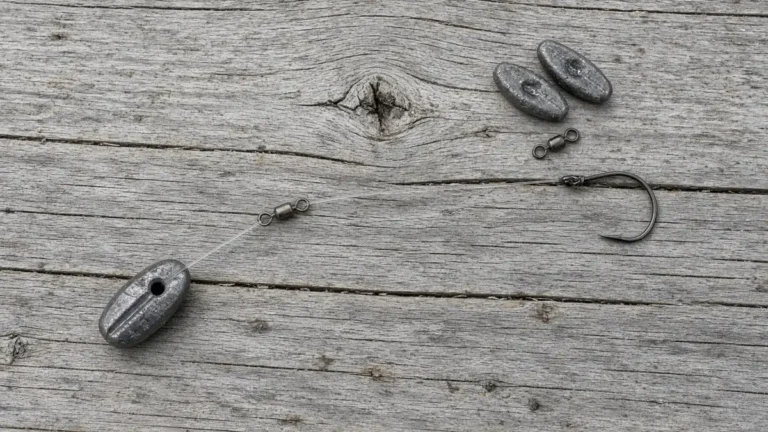
This is the most productive catfish rig in North America and your default whenever you’re unsure. From top to bottom:
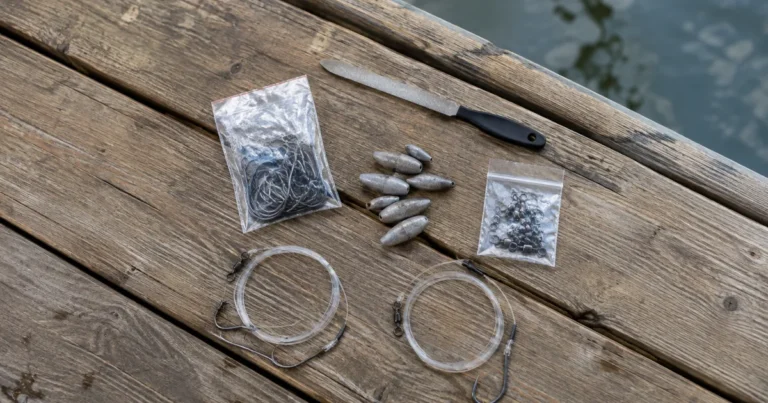
- Slide a no-roll or egg sinker onto your main line, 1 to 3 oz depending on current.
- Tie a barrel swivel below it.
- Add a 12 to 24 inch leader of 20 to 40 lb mono or fluorocarbon.
- Finish with a circle hook: #1 to 2/0 for average channel cats, 3/0 to 5/0 for bigger channels and smaller blues.
The line slides through the sinker, so a catfish can pick up the bait and swim off without feeling the weight. That means fewer dropped baits. The swivel stops line twist from cut bait spinning in current. Our slip sinker rig guide walks through every step and adjustment. Tie four or five at home so a snag doesn’t cost you fishing time.
Step 5: Bait It With Fresh Cut Bait
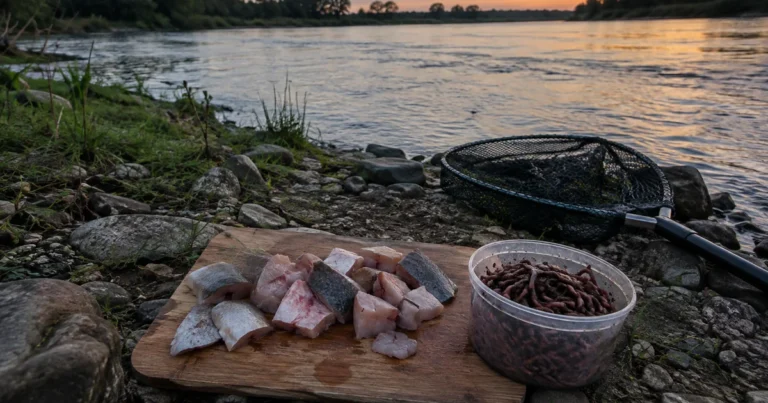
Cut bait is the most consistent choice for channel and blue catfish in almost every situation. Top picks:
- Shad (gizzard or threadfin), where legal. It’s what blues eat naturally.
- Skipjack herring in rivers that have them. The oily flesh leaves a strong trail.
- Carp, suckers and other rough fish, often legal to use from your own catch. Check your state’s bait-fish rules.
Cut 1 to 2 inch chunks with some skin left on for smaller channel cats, and 2 to 4 inch chunks for bigger fish. Slice at an angle to expose more flesh, then make a small slit in the skin side so scent leaks out faster.
No cut bait? Chicken liver is a cheap, effective channel cat bait. It’s soft, so wrap it with bait thread or tie it in a small piece of pantyhose. One exception to all of this: flatheads want live bait. Our catfish bait guide by species covers each option.
Step 6: Fish Dawn, Dusk and Night
If you can control only one thing, control the time of day. Low light (dawn, dusk, overcast days and night) gets every species feeding with more confidence. Bright sun pushes catfish deeper or tighter into cover, where they turn sluggish and picky.
Water temperature sets the overall mood. Catfish feed hardest between 70 and 85°F and slow way down below 50°F.
Stuck with daytime trips? Pick stained or muddy water over clear water, since catfish in murky water are already hunting in near darkness. If clear water is all you have, fish the first and last hour of daylight or work deep, shaded structure.
Read the Bite and Bring It In
- Set the rod in a spike holder at about 30 to 45 degrees, tip pointing slightly downstream or across the current to keep slack out of the line.
- Steady bend: that’s current or wind, your baseline.
- Light, repeated taps: a fish is checking the bait. Stay ready, but don’t strike.
- Rod loads up and stays loaded: pick it up and reel steadily. Never yank a circle hook. It turns into the corner of the mouth on its own.
Your First Month on the Water
- Week 1: find out which species live in your water, pre-tie five slip sinker rigs, and pick two or three casting targets at one spot. The goal is one bite on cut bait or chicken liver.
- Week 2: try a different bait on each of two trips at the same spot, and start a simple trip log.
- Week 3: move one session to dawn, dusk or night, and scout a second spot.
- Week 4: fish your best bait, spot and timing on purpose, not as an experiment.
After 30 days you’ll have a local pattern you can repeat, and that’s when catfishing stops being luck.
Frequently Asked Questions
What is the best bait if I can only bring one?
Fresh cut bait, such as shad or skipjack herring, fished on a slip sinker rig. It works on channel and blue catfish in nearly every condition. The one exception is flatheads, which want live bait.
Do catfish only bite at night?
No. Channel and blue catfish feed both day and night, though activity usually picks up after dusk, especially in warm months. Flatheads are the exception: they are far more strictly nocturnal.
Do I need a boat to catch catfish?
No. Bank fishing done right can produce as well as a boat, and at night bank anglers often have the edge because boat traffic and fishing pressure drop off. Pick a spot where good structure sits within casting range.
How long should I stay on one spot?
Give a spot with good structure 30 to 45 minutes. If nothing happens, move to the next one. Stay longer if you are after flatheads or trophy fish, where patience is part of the plan.
Tight lines,
— David