Bass Fishing After a Cold Front: Slow Down, Size Down, Fish Tight
A cold front blew through last night. This morning the sky is clear and bright blue, the air is crisp, and the lake feels dead. It’s the worst scenario in bass fishing, and it’s also one of the most common. The good news: the bass haven’t gone anywhere. Here is what’s happening and how to still get bites, using the approach from our complete bass fishing system.

Bass Fishing Mastery: the complete system this article comes from, as an instant PDF. Get the guide — $17
What a Cold Front Does to Bass
Behind a front, the barometric pressure rises sharply and the air turns cold. Bass feel the pressure change through their swim bladder (we explain the mechanism in how barometric pressure affects bass), and the result is lethargic fish that don’t want to chase.
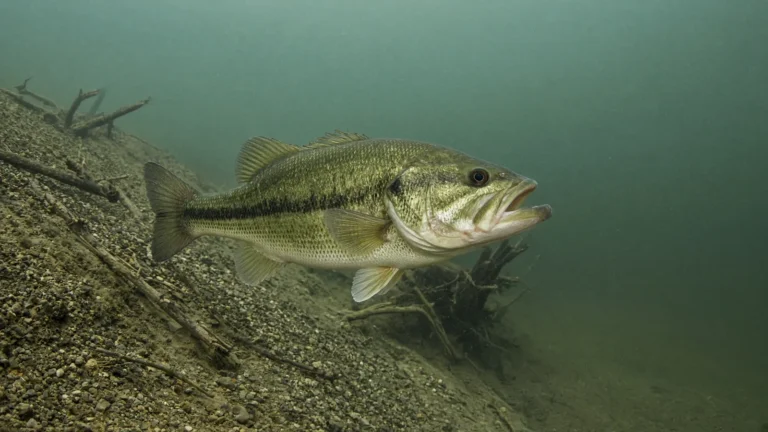
Here’s the key read: the bass are not gone. They’re tight and grumpy. They’ve moved deeper and hugged cover, and their strike zone has shrunk. A fish that would have chased a spinnerbait ten feet yesterday won’t move ten inches today. Everything you change follows from that.
The Three Adjustments
1. Slow down by half
Whatever speed you’d normally fish, cut it in half. Then if nothing happens, slow down again. On a post-front day, the lure has to stay in front of the fish long enough for it to decide.
2. Size down by one
Drop one size in everything: a smaller bait, a lighter jig. Post-front bass reject big, fast profiles that they’d hit on a falling barometer.
3. Fish tight
The bait must land in the living room, not the neighborhood. Put it right against the best cover, on the shady or dense side, and keep it there. A cast that lands four feet away from the cover is a wasted cast today.
The Lures That Still Work
- Shaky head: a 4 to 5 inch finesse worm on a stand-up jig head. Drag it to the target, let it settle, and shake it in place with your wrist, not your arm, so the tail waves while the head stays on the bottom.
- Finesse jig: 1/8 to 1/4 oz on light fluorocarbon and spinning gear, with a small craw trailer. It’s built for clear water, cold water and post-front conditions.
- Drop shot: it holds a soft plastic at a fixed depth indefinitely, right in front of a fish that won’t chase. See our step-by-step drop shot guide.
- Ned rig: it catches bass in every season and every condition, including after cold fronts when almost nothing else produces. Let it fall, shake it 2 or 3 times, pause 5 to 8 seconds, drag it 6 inches, and repeat. Fish it slower than feels natural.
Where to Fish
- Deeper water right next to the cover that was producing before the front. The fish moved deep and tight, not across the lake.
- The shady and dense side of the best cover in the area.
- If you’re fishing from the bank, the spots with deep water close to shore: bluffs, the dam face, channel-swing banks.
Post-front bass are also one of the situations where a slow, persistent presentation can draw an aggression strike: a fish that isn’t hungry can still hit something that keeps bothering it. Be patient on the best piece of cover before you leave it.
Set Honest Expectations
Expect fewer bites, and convert the ones you get. That means a sharp hook, a properly set drag and a patient hookset, because on a day like this, one missed fish can be half your day. A post-front trip is also a good day to practice the finesse techniques that are hard to evaluate on busy days.
A Fall Cold Snap Is Different
Don’t confuse the bluebird day after a hard front with the first cold snap of fall. In fall, a cold snap that drops the water 5 degrees or more often triggers some of the best fishing of the year within 24 to 48 hours, because the shad start moving and the bass follow them. If that’s your situation, fish the fall shad pattern, not this playbook.
Tight lines,
— David