Most bass anglers don’t quit because the fish aren’t there. They quit because nobody gave them a system. What they got was scattered tips, videos with no context, and tackle-company marketing. This page is the system: how bass think, where they live month by month, and the handful of techniques that catch them in almost any water in America.
Everything here comes from the same foundation: you don’t need a list of rules. You need to know why bass do what they do. Once you understand why a bass holds on a point or eats on a falling barometer, you stop guessing and start fishing with a plan.
On this page
- Know Your Fish: Three Species, Three Strikes
- Where Bass Live: Structure, Cover and the Spot Where They Meet
- The Seasonal System: Fish the Thermometer, Not the Calendar
- Weather: The Barometer Explains Most Slow Days
- Five Techniques That Catch Bass Almost Anywhere
- No Boat? You Have Two Advantages
- Rivers: Moving Water Makes Bass Predictable
- Four Mistakes That Cost Anglers the Most Fish
- Frequently Asked Questions
Know Your Fish: Three Species, Three Strikes
There are three bass you’ll run into on most US waters, and they don’t live the same way:
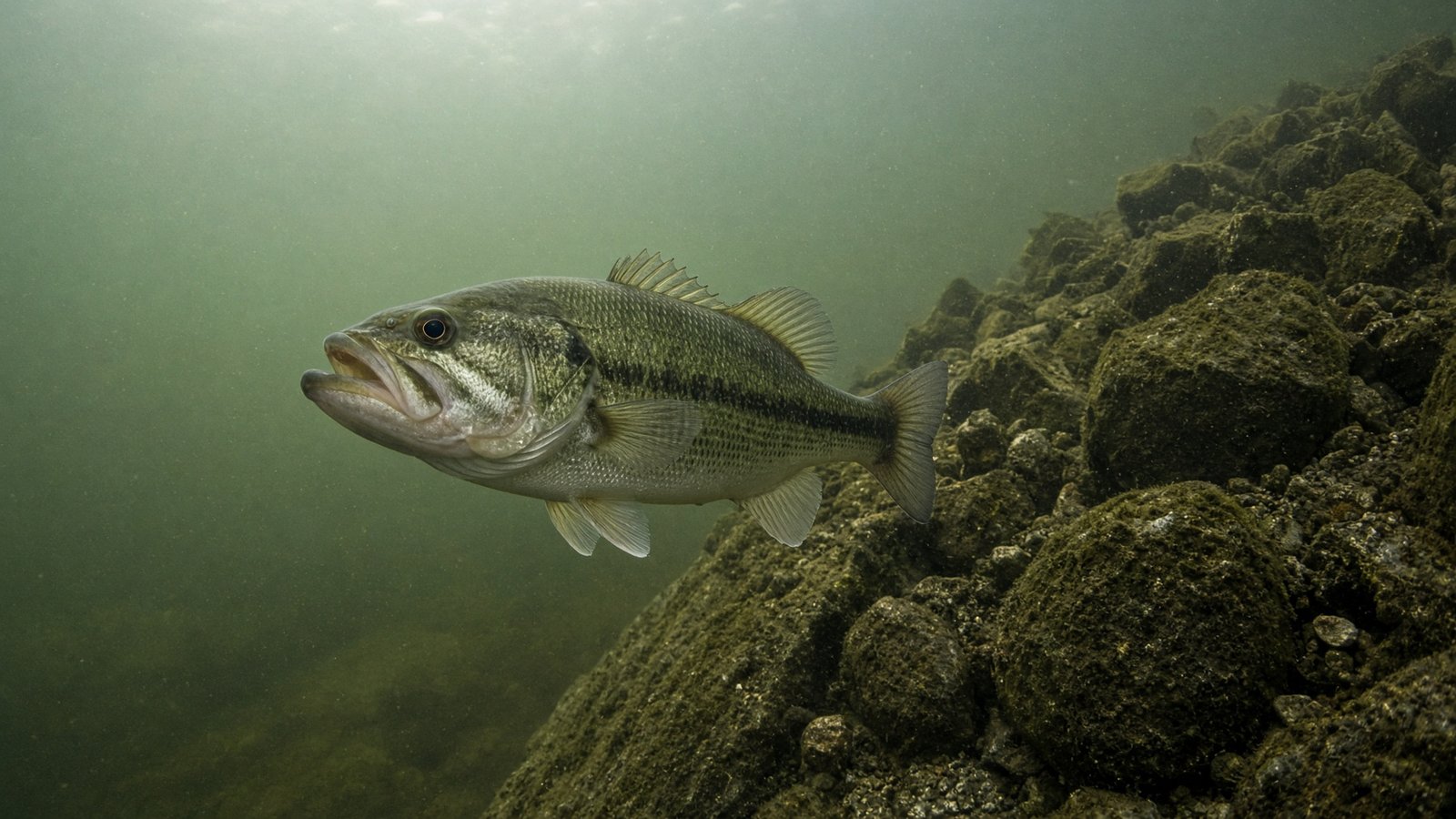
- Largemouth bass: warm, weedy, still or slow water. Ponds, lakes, reservoirs, backwater sloughs. A pure ambush predator and the biggest of the three.
- Smallmouth bass: clear, cool, rocky water. Highland rivers, streams, clear reservoirs. Pound for pound the strongest fighter, and a crawfish specialist.
- Spotted bass: clear highland reservoirs and fast rocky rivers. Similar to largemouth, but they school much more and often hold deep. Drop shot and finesse water.
Then there are three reasons a bass bites, and each one calls for a different approach:
- Hunger strike: fish are actively chasing food. Cover water with faster lures in natural colors during dawn, dusk and overcast days.
- Reaction strike: a reflex triggered by sudden movement. A crankbait deflecting off a rock or a lure ripped out of grass does it.
- Aggression strike: a bass protecting its nest or its space. Slow, persistent presentations near the fish, mostly during the spawn and after cold fronts.
One more thing to know about bass senses: the lateral line lets a bass feel vibration long before it can see your lure. That’s why spinnerbait blades, rattles and big thumping baits work in dark or muddy water. And in shallow, clear water, a bass can see you on the bank. Long casts, a low profile and dark clothing matter.
Where Bass Live: Structure, Cover and the Spot Where They Meet
An average angler on the right spot will always outfish an expert on the wrong one. Location beats technique. To read any lake, separate two things:
- Structure is the shape of the bottom: points, humps, ledges, drop-offs, creek channel edges, flats. You usually can’t see it from the surface.
- Cover is anything physical in the water: rocks, wood, grass, docks, brush piles, stumps.
The best bass water on any lake is where structure meets cover. A rock pile on the tip of a point that drops into a creek channel holds fish in more than one season. Train your eye to find those intersections and every lake gets smaller.
The locations that produce most consistently:
- Points: the most reliable bass location in freshwater. Position parallel to the slope, cast up the point and retrieve down it so your lure stays at the right depth longer.
- Creek channels and ledges: the highways bass use to move between shallow feeding areas and deep holding water. The outside bends of old channels are especially good.
- Grass edges: bass sit where the grass ends and open water begins. Fish parallel to the edge.
- Wood: hit the root ball of a laydown first (deepest, most complex, biggest fish), then work along the trunk. On sunny days, bass sit on the shaded side.
Wind moves bass too. The bank that has been taking wind all day has been collecting food all day.
The Seasonal System: Fish the Thermometer, Not the Calendar
A pattern that catches 20 fish in October may not get a single bite in January on the same lake. The trigger is always water temperature, not the date. A $10 thermometer tells you which season your lake is really in.
Winter (roughly December to February)
Bass school tight on the deepest stable structure: 20 to 40 feet on Southern reservoirs, shallower in the North. They feed in short windows, usually the warmest part of the day, from noon to about 4 PM. Blade baits, jigging spoons, slow finesse jigs and drop shots. If your retrieve feels slow, cut it in half. Find one fish and you’ve likely found twenty.
Pre-spawn (roughly March to April)
Serious movement starts when water reaches 53 to 55°F. Bass stage on secondary points and channel edges in 8 to 15 feet of water near spawning coves, and big females feed hard. From 50 to 58°F, fish a jerkbait with 5 to 8 second pauses or slow-roll a spinnerbait. From 58 to 65°F, rip a lipless crankbait through early grass or swim a swimbait along grass edges.
The big fish pattern: the largest females stage in the deepest part of the pre-spawn range, on 15 to 20 foot channel edges near major spawning coves. That’s where big swimbaits and football jigs give you a real shot at a trophy.
The spawn (water at 65 to 75°F)
Males fan round beds 2 to 4 feet wide on hard bottom (sand, gravel, clay, shell) in 1 to 6 feet of water in protected coves. Timing depends on latitude: February to March in Florida and the Deep South, April to May in the Midwest, May to June in the Great Lakes states. Polarized glasses are non-negotiable. Stay back, cast beyond the bed, and be patient: a bedding bass may ignore your lure 30 times before it picks it up.
Summer (roughly June to August)
Summer runs on the clock. From dawn to about 9 AM, bass feed shallow in 1 to 6 feet: topwater, frogs, spinnerbaits. From noon to 5 PM, they move to 15 to 25 feet on ledges, humps and channel edges: football jigs, deep-diving crankbaits, Carolina rigs. They come back shallow in the evening. On many Southern and Midwestern reservoirs, big schools stack on channel ledges in 18 to 22 feet all summer.
Fall (roughly September to November)
The simplest rule of the year: find the shad and you’ve found the bass. Baitfish move into creek arms and bass follow them. Lipless crankbaits, swim jigs, spinnerbaits and swimbaits in shad colors, sized to match the local shad. When water drops below 58°F, slow down and switch to jigs, Texas rigs and medium-diving crankbaits.
Bass Fishing Month by Month
A typical year on a mid-latitude US lake. Your water can run weeks ahead or behind, so match the temperature column, not the month.
| Month | Typical water temp | Where bass are | What to throw |
|---|---|---|---|
| January | 38 to 48°F | Deepest structure, 20 to 40 ft | Blade baits, jigging spoons, slow jigs |
| February | 42 to 52°F | Deep points, channel bends | Slow finesse jig, blade bait, drop shot |
| March | 50 to 60°F | Staging areas, 10 to 18 ft | Jerkbait, slow-rolled spinnerbait, swimbait |
| April | 58 to 68°F | Pre-spawn to spawning, 4 to 15 ft | Lipless crank, jig, swimbait, jerkbait |
| May | 65 to 75°F | Spawning flats, 1 to 6 ft | Ned rig, drop shot, finesse jig |
| June | 70 to 80°F | Shallow to transitional | Frog, topwater, swim jig (AM); jig or drop shot (PM) |
| July | 78 to 88°F | Deep ledges and humps, 15 to 25 ft | Football jig, deep crankbait, big swimbait |
| August | 80 to 90°F | Deep at midday, shallow at dawn and dusk | Same as July, plus topwater after dark |
| September | 70 to 80°F | Creek arms, following the shad | Lipless crank, swim jig, swimbaits |
| October | 60 to 72°F | Creek backs, shallow flats | Shad-colored crankbaits, spinnerbaits, swim jig |
| November | 50 to 62°F | Transitioning deeper | Jig, Texas rig, medium crankbait |
| December | 44 to 54°F | Deep structure again | Finesse jig, drop shot, blade bait |
Want the complete 12-month system? Bass Fishing Mastery breaks down every season in detail, with the exact locations, lures and retrieve speeds for each water temperature, plus the big fish patterns most anglers never learn.
Weather: The Barometer Explains Most Slow Days
A bass’s swim bladder reacts to air pressure, and that changes how it feeds:
- Falling pressure ahead of a front is often the best fishing of the week. The 12 to 36 hours before a big low arrives brings the most aggressive bass. Fish fast and cover water.
- Rising pressure after a cold front is the toughest scenario. Bass go deep and tight. Use the smallest lures, the slowest retrieves and the deepest water.
- Overcast skies and light rain keep bass active all day. Search baits work.
- Thunderstorms: get off the water. No exceptions.
Five Techniques That Catch Bass Almost Anywhere
1. The Texas rig
The foundation. Weight choice: 3/16 oz for shallow calm water, 3/8 oz for moderate depth or a little wind, 1/2 to 3/4 oz for depth, heavy cover or wind. Use a 3/0 offset EWG hook for a 6-inch worm and 4/0 to 5/0 for bigger plastics. The most common mistake is setting the hook on the first tap. Reel down, feel the weight of the fish, then sweep hard.
2. The drop shot
It keeps a soft plastic at a fixed depth as long as you want, which makes it deadly on clear water, pressured fish and bass that won’t chase. Tie a size 1 or 2 hook with a Palomar knot, leave 18 to 24 inches of tag below it for the weight, and nose-hook the bait. Shake in place without lifting the weight.
3. Flipping and pitching
Precision for heavy cover. Flipping works from 8 to 20 feet, pitching from 15 to 40. Let the bait fall on a slack line and watch for the line to jump or move sideways: many of the biggest bass bite on that first fall.
4. The Ned rig and finesse
A buoyant plastic on a 1/15 to 3/16 oz mushroom head that stands up off the bottom. Let it fall, shake it 2 to 3 times, pause 5 to 8 seconds, drag it 6 inches, repeat. Fish it slower than feels natural. It catches bass in every season, including after cold fronts.
5. Topwater
Walk-the-dog baits are the most versatile. Hold the rod at 45 degrees, short wrist twitches, pause 1 to 3 seconds. Most strikes come on the pause. Don’t react to the splash: wait to feel the weight, then sweep sideways.
One bonus rule for jerkbaits in cold water: the pause gets longer as the water gets colder. Below 50°F, pause 8 to 12 seconds. From 50 to 60°F, 3 to 5 seconds. Above 65°F, 1 to 2 seconds.
No Boat? You Have Two Advantages
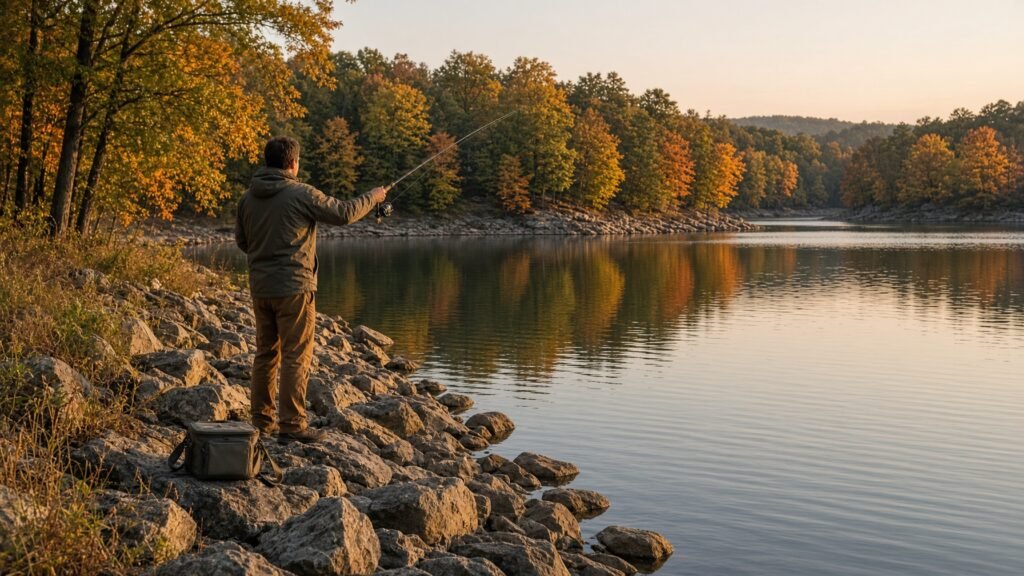
Bank fishing gets called a limitation. It isn’t. On foot you arrive quietly while boats announce themselves with motors, hull slap and wakes. And you stand right on the strip of water a boat’s cast only reaches at the end of the retrieve. In spring, fall and every dawn and dusk, that strip is where bass live.
Keep it light: one 7-foot medium rod, a spinnerbait to find fish, a Texas rig to finish them, one topwater for low light, and polarized glasses. Plan a short loop of 3 to 5 reachable spots on a satellite map, give each one about fifteen honest minutes, and don’t skip the boat ramp area. It sits on hard bottom near deep water and gets very few casts. Fall is the bank angler’s best season: bait pushes shallow and the summer boat traffic is gone.
Rivers: Moving Water Makes Bass Predictable
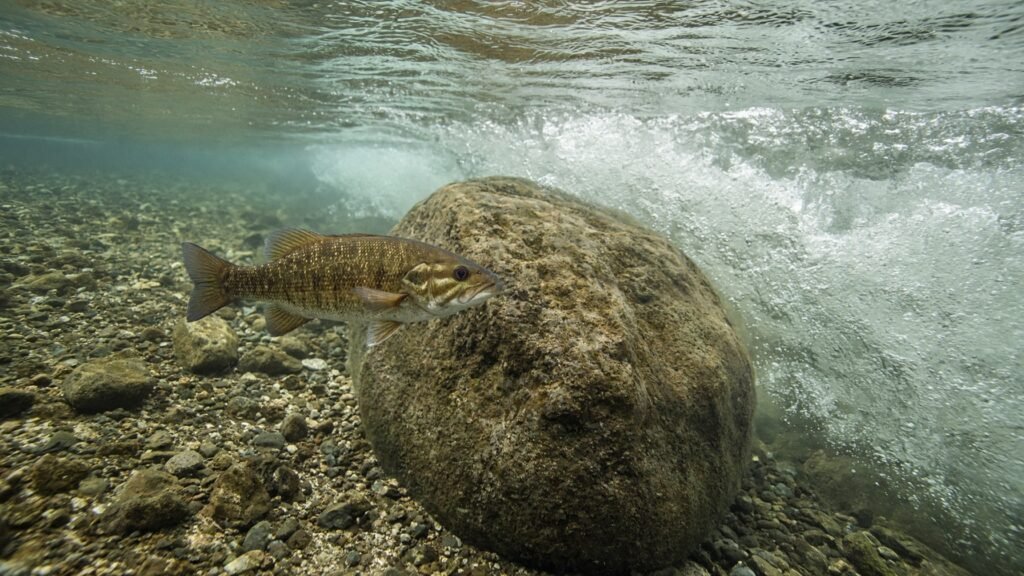
On a river, the current makes most decisions for the bass. It holds in slow water next to fast water and lets the current deliver food. Look for seams, where fast water meets slow water behind rocks, pilings, points and wood. Outside bends are the prime real estate: deepest water, best wood and a steady food supply. River bass face upstream, so approach from downstream and cast above your target so the current carries the bait in naturally.
Four Mistakes That Cost Anglers the Most Fish
- Casting at the fish instead of past it. Land your lure 6 to 10 feet beyond the target and bring it by naturally.
- Leaving before the last 30 minutes of light. That window is a scheduled feeding period. Plan your trip to end in the dark.
- Camping on one spot all day. A caught fish tells you about every similar spot on the lake. Fish the pattern, not the place.
- Ignoring the free stuff. Set your drag to about 25 to 30% of your line’s rated strength, keep hooks sharp, and wet every knot before you cinch it.
Frequently Asked Questions
What is the best time of day to catch bass?
In summer, bass feed shallow from dawn to about 9 AM and again from 5 PM to dark, then move to 15 to 25 feet at midday. In winter it flips: the warmest part of the day, roughly noon to 4 PM, is best. In every season, the last 30 minutes of light is a scheduled feeding window, so plan your trip to end in the dark.
At what water temperature do bass spawn?
Bass spawn when the water reaches about 65 to 75°F. That happens around February and March in Florida and the Deep South, April and May in the Midwest, and May and June in the Great Lakes states. The trigger is the temperature, not the date.
What is the best bass lure for beginners?
A Texas-rigged plastic worm. The plastic worm has caught more bass than any other lure, and one simple setup covers most situations: a 7-inch green pumpkin worm, a 3/8 oz bullet weight and a 3/0 offset EWG hook. Cast it near cover, let it sink, drag it slowly and pause.
Where do bass go in the summer?
During the middle of the day they drop to 15 to 25 feet on ledges, humps and creek channel edges. They come back shallow, into 1 to 6 feet, at dawn, at dusk and after dark. On many Southern and Midwestern reservoirs, big schools stack on channel ledges in 18 to 22 feet all summer.
How does barometric pressure affect bass fishing?
Falling pressure ahead of a front is often the best fishing of the week, especially the 12 to 36 hours before a big low arrives. Rising pressure after a cold front is the toughest scenario: bass go deep and tight, so use smaller lures, slower retrieves and deeper water.
Can you catch bass from the bank?
Yes. On foot you arrive quietly, and you stand right on the shallow strip of water where bass live in spring, fall and every dawn and dusk. Fall is the bank angler’s best season: bait pushes shallow and the summer boat traffic is gone.
More Bass Fishing Guides
- Why Bass Stack on the Windblown Bank (And Why You Keep Fishing the Wrong Side)
- How to Rig and Fish a Texas Rig, Step by Step
- Where Pre-Spawn Bass Stage (And Where the Big Females Wait)
- Summer Bass Fishing: The Time-of-Day Game
Go Deeper: Bass Fishing Mastery
This page is the map. Bass Fishing Mastery is the full territory: the complete month-by-month system, the complete lure encyclopedia, the six essential knots, fish finder reading, the moving water system for rivers, creeks and tidal bass, the bank angler’s system, the 10 deadliest mistakes with the exact fix for each, and a 15-situation playbook for problems on the water.
It’s an instant PDF download that works on phone, tablet and computer. Nothing ships, and every future update is free.
Tight lines,
— David