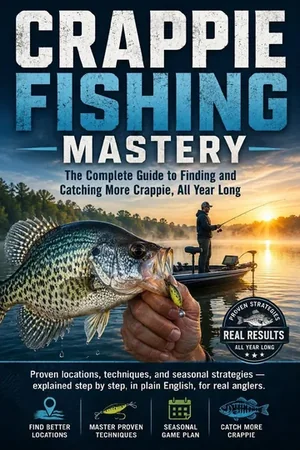
Ice Fishing for Crappie: Find the Basin, Fish Above Them
If you live in the ice belt, crappie season doesn’t end when the lake locks up. It just gets quieter. No boat, no launch, fish packed tighter than at any other time of year, and a fresh fish fry in January. Ice fishing for crappie is also the purest version of the sport: location, depth and patience, nothing else. This is the hardwater chapter of our complete crappie fishing system, boiled down to what you need on the ice.
Crappie Fishing Mastery: the complete system this article comes from, as an instant PDF. Get the guide — $17
Safety First, Every Single Trip
No crappie is worth going through the ice. These rules come before any tackle talk:
- No ice is 100 percent safe. Thickness varies across a single lake. Springs, current, vegetation and docks all thin it where you can’t see it.
- About 4 inches of new, clear ice is the general minimum for walking. Machines and vehicles need a lot more, so check your state’s guidance. Cloudy, white, honeycombed or refrozen ice is far weaker, and the guideline numbers mean nothing on it.
- Check as you go. Use a spud bar or an auger test hole every few dozen steps early and late in the season. Ice that held last weekend is a rumor, not a fact.
- Carry the kit: ice picks worn around your neck, rope, a flotation suit or PFD, and your phone in a waterproof pouch.
- Never go alone early or late in the season, and spread out when you walk with partners.
When in doubt, don’t. There’s always another weekend.
Where Crappie Live Under the Ice
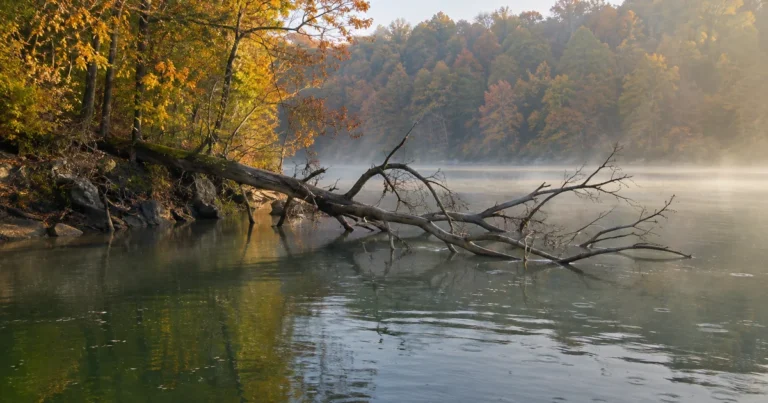
Winter crappie concentrate in and around the deep basins: the deepest soft-bottomed flats and holes of the lake and its bays, commonly 15 to 30-plus feet depending on the water. That’s the big picture. Here’s the pattern inside it:
- Basin edges beat the middle. Where the deep flat meets the first slope, or where hard bottom turns soft, out-produces the featureless center.
- Features concentrate fish. Deep weedline remnants, deep brush and cribs hold schools where the basin has little else.
- Suspension is the rule. Ice crappie hover well off bottom, following clouds of zooplankton. A school over 24 feet of water might sit at 12 to 16 feet. That’s why anglers who only fish the bottom foot catch bluegills and never see the crappie above them.
- They roam. Basin crappie drift through the day in loose schools. The angler who sits waits for traffic. The angler who moves goes and finds it.
Do your map homework before your boots hit the ice: contour map out, basins and basin edges marked, and a plan for where your first holes go. If you fished the lake in late fall, your fall crappie spots tell you which way the schools were heading when the water cooled.
The Gear That Matters
- Rod and reel: a 24 to 32 inch light or ultralight ice rod with a sensitive tip or a spring bobber (a wire indicator that shows bites your hand will never feel), a tiny spinning reel, and fresh 2 to 4 lb line.
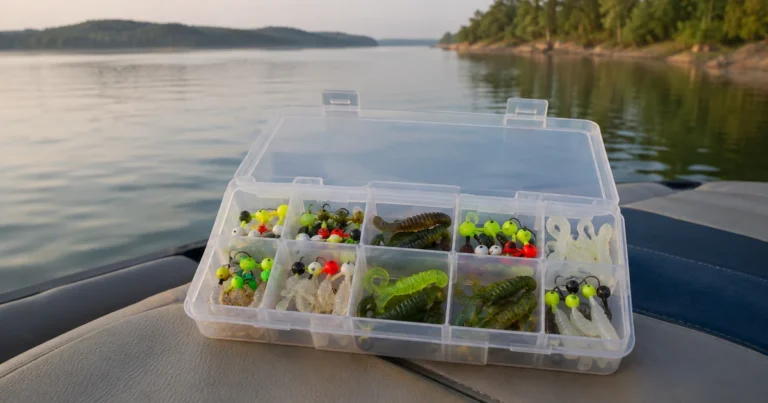
- Lures: small tungsten jigs in the 1/32 to 1/16 oz class, tipped with waxworms, spikes or plastics. Tungsten is heavier for its size, so it reaches depth fast and shows clearly on sonar. Add a few small jigging spoons and darting jigs to call fish in and target the aggressive ones.
- Glow: glow finishes matter in deep basins and at twilight. Charge them with your headlamp and recharge often. For the rest of the color question, see our crappie jig color guide.
- Auger: a hand auger is cheap, quiet and fine for a few holes. A drill with an auger bit or a powered auger pays for itself the day you commit to drilling twenty.
- Sonar: not optional here. A flasher or ice-mode graph that shows your jig and the fish in real time is the single most important item in ice fishing. If you go more than twice a winter, buy one before anything else.
- Comfort: insulated boots, layers, a bucket or sled seat. Comfort equals endurance, and endurance equals fish.
The 7-Step Ice Crappie System
- Drill a spread first, fish second. On arrival, drill a line or grid of 8 to 15 holes across the basin edge and over the flat. Get all the noise done in one session.
- Hole-hop with the sonar. Drop the transducer, look for suspended marks, and give each hole 5 to 10 minutes at most with no fish on screen. The fifteen-minute rule from open water becomes the five-minute rule on ice.
- Fish above them, always. Drop your jig to just above the marks. Crappie under the ice will rise a surprising distance for a bait and almost never dive for one.
- Lift to trigger. If a mark rises toward your jig and stalls short, slowly lift the jig away from it. The retreating meal triggers the bite like nothing else. This is the most valuable move in ice crappie fishing, and it goes against every instinct you have.
- Shake, pause, hold. Tiny rapid shakes to get attention, then a dead-still pause. Ice crappie overwhelmingly eat the pause. If they’re hot, a jigging spoon speeds things up. If they’re cold, go to your smallest tungsten with a single waxworm and hold painfully still.
- Watch for the up-bite. A crappie rising to inhale the jig takes its weight off the line. The spring bobber straightens or the line goes slack. That’s a fish. Lift right away.
- Follow the school. When a hot hole dies, the school moved along the edge. Don’t sit over the memory. Slide to the next holes in your spread and find them again on sonar.
Timing: The Last Two Hours of Light
The classic ice crappie window is the last two hours of daylight into early dark, with dawn a close second. Many basin lakes fish best exactly when most anglers are packing up. Plan for it: save your best holes, your freshest bait and your freshly charged glow jigs for the last hour. Crappie see well in low light, the same reason night fishing for crappie works so well in summer.
Across the whole winter, warm and stable spells produce the best bites. Bites are small all season. A half-inch of line movement is a fish, so believe it.
Cold-Weather Fish Care
Fish headed for the pan go straight onto the ice or into a bucket. Winter crappie chill firm and clean and are the best-eating fish of the year. Fish going back down the hole should go back fast: in hard-freeze air, eyes, gills and fins get damaged quickly. Keep release fish out of the wind, handle them with wet hands, and return them promptly.
Living in the South?
You won’t drill a hole, but the lessons still apply. Deep winter crappie in open water behave the same way: suspended, packed in big schools, and slow. Fish small jigs, fish above the marks, lift to trigger and hold still. The ice system is vertical finesse fishing, and it transfers straight to your winter boat fishing.
Your Next Ice Trip Checklist
- Build the safety kit first: picks, rope, spud bar, flotation. Then buy tackle.
- Mark your lake’s basins, basin edges and any deep cribs or weedlines, and plan your first drilling spread on paper.
- Drill 10 or more holes, put the sonar in every one, give each a five-minute verdict, and fish above the marks.
- Practice the lift-to-trigger on the first cooperative school you find. It takes reps to teach your hands to pull a bait away from a fish.
Tight lines,
— David