Walleye Rigs: The 8 Setups and When to Use Each
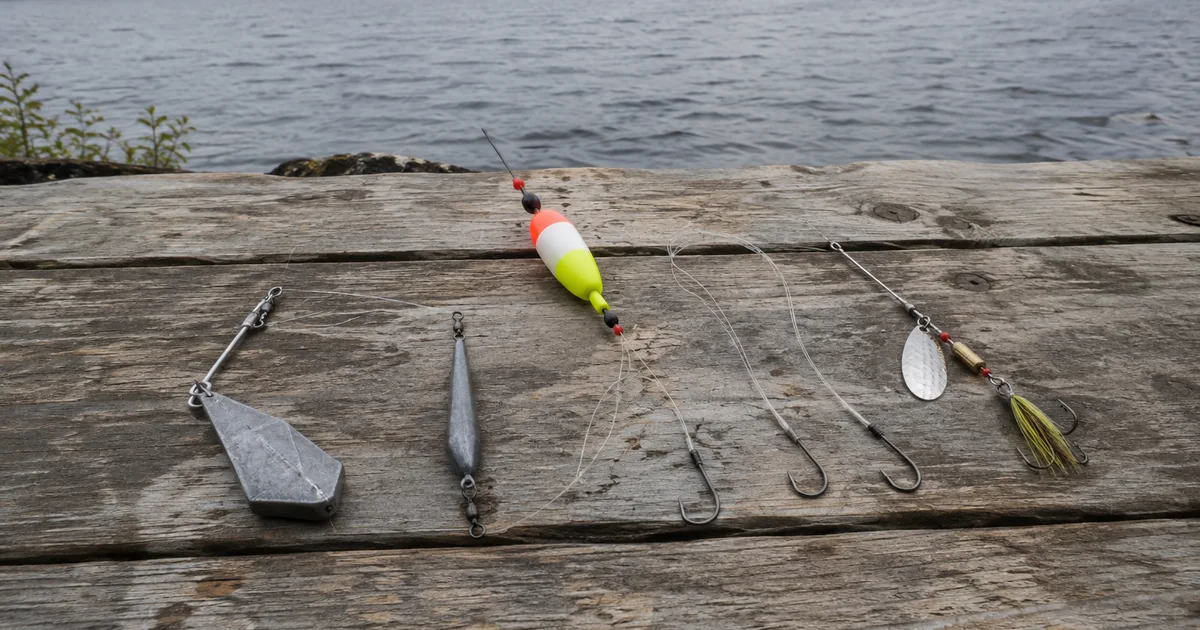
Walleye rigs come down to eight setups, each answering a different problem: a jig and minnow for bottom control, a walking sinker rig for fish that will not chase, a crawler harness behind a bottom bouncer for covering summer structure, a slip bobber for holding a bait in one place, a three-way for current, plus a stinger add-on and two trolling setups for open water. Tie them at home, fish them for a lifetime. Here is each one, component by component, from our complete walleye fishing system. They all aim at the same narrow band: the bottom 2 feet, with bait rigs riding 6 to 18 inches up.
Walleye Fishing Mastery: the complete system this article comes from, as an instant PDF. Get the guide — $17
Rig 1: Jig and Minnow
From the top down: 10 lb braid, a uni-to-uni knot, 3 feet of 8 lb fluorocarbon, then the jig. Weight follows depth, lightest that keeps bottom contact: 1/16 oz to 10 feet, 1/8 oz to 15, 1/4 oz to 25, 3/8 oz or more deeper or in wind and current. Hook the minnow through the bottom lip and out a nostril for casting and dragging, through the mouth and out the back of the skull for vertical work. Retrieves, bite detection and fixes are all in our jig and minnow how-to.
Rig 2: The Walking Sinker Rig
The rig for neutral fish, the ones that show on sonar and ignore everything. Thread a walking sinker on the main line so it slides, then a bead, a #7 barrel swivel, a 3 to 8 foot snell of 6 to 8 lb fluorocarbon, and a #4 or #6 octopus hook. Bait it with a minnow in cold water, a leech from 55 to 75°F, or half a crawler.
The sliding sinker is the whole idea: a walleye can pick the bait up and swim off feeling nothing. Move it at 0.3 to 0.8 mph along one depth, with 1/4 oz to 12 feet, 3/8 oz to 20 and 1/2 oz beyond. On the bite, a tick-tick or just building weight, open the bail, count 3 to 5 seconds, reel tight and sweep. Rigs like this live on contours, and the breakline and the big five structures is how you pick one.
Rig 3: Crawler Harness and Bottom Bouncer
The summer workhorse: 3 to 4 feet of 10 to 14 lb leader, tandem snelled #4 and #6 hooks, 6 to 10 beads, a quick-change clevis with a #3 or #4 Colorado blade, and a loop for the snap, all riding behind an L-shaped bottom bouncer at 1 oz per 10 feet of depth.
Pull it at 0.8 to 1.5 mph with the wire tapping bottom on a 45-degree line angle and the harness riding 1 to 2 feet up. A bouncer and harness at 1.0 mph along a breakline may be the most reliable way there is to catch walleye from June through September. Blade size and color matter far less than speed and depth.
Worked example: a 20-foot breakline at 72F in late July
Say the surface reads 72°F in late July and the slope off an 11-foot flat crosses 20 feet for most of a half mile. That is bouncer and harness water, and the numbers set themselves:
- Bouncer: 1 oz per 10 feet at 1.0 mph, so 2 oz on the 20-foot contour.
- Harness: 3 to 4 feet of 10 to 14 lb leader, tandem #4 and #6 snelled hooks, 6 to 10 beads, a #3 or #4 Colorado blade. Gold in stained water, silver or chartreuse in clear.
- Line out: enough that the wire leg taps bottom on a 45-degree angle. Any flatter and you are dragging.
- Speed: start at 1.0 mph, stay inside 0.8 to 1.5. The blade should just barely turn at your slowest.
- Height: wire tapping, harness riding 1 to 2 feet up.
Same slope at 46°F in November and none of it applies: the bouncer goes back in the tray and a jig or walking sinker rig at 0.5 mph takes over.
Rig 4: The Slip Bobber
The most underrated rig in walleye fishing, and the one that holds a bait dead still. Top to bottom: a bobber stop knot, a small bead, the slip float, one or two small split shot 12 to 18 inches above the hook, then a #4 or #6 octopus hook or a 1/32 to 1/16 oz jig with a leech, a minnow or a chunk of crawler. Set the stop so the bait rides 6 to 18 inches off bottom: 13.5 to 14.5 feet over a 15-foot rock pile. Because the stop reels through the guides, one rod covers 5 feet and 20 feet with no other change.
Rig 5: The Three-Way River Rig
Current needs its own rig. Tie the main line to a three-way swivel, run an 8 to 12 inch dropper of lighter mono to a bell sinker, and a 2 to 4 foot leader to a floating stickbait or a plain hook and minnow. The lighter dropper is deliberate: a snag costs you a sinker, never the rig. Hold it in the flow or troll it slowly upstream so the bait fights the current at barely-moving ground speed, which is what makes river fish commit. Where to put it, from tailrace seams to the heads of holes, is in river walleye below dams.
Rigs 6, 7 and 8: Stinger, Trolling Leader and Leadcore
- The stinger add-on. A #10 treble on a 2 to 3 inch loop of 20 lb braid, girth-hitched to the jig’s hook eye, one point lightly set near the minnow’s tail. Carry six pre-tied; it is the fix for fish that tap and never commit.
- The trolling leader. Six to 8 feet of 10 lb fluorocarbon to a small ball-bearing snap swivel, then the crankbait, run flat or off planer boards. Straight 8 to 10 lb mono still earns its place on trolling rods: the stretch cushions a soft walleye mouth.
- The leadcore setup. Backing, 3 to 5 colors of leadcore, 15 to 30 feet of 10 lb fluorocarbon, a small snap, a stickbait. Leadcore sinks about 5 feet per color at 2 mph, so 4 colors puts a small bait near 20 feet, which is how you reach fish suspended over a basin.
Which Rig, When
| Rig | Situation: depth, current, speed | Components, top to bottom |
|---|---|---|
| Jig and minnow | Any depth to 25 ft+, no speed to hold | Braid, uni-to-uni, 3 ft of 8 lb fluoro, 1/16-3/8 oz jig by depth |
| Walking sinker rig | Neutral fish on a contour, 10-25 ft, 0.3-0.8 mph | Sliding sinker, bead, #7 swivel, 3-8 ft snell, #4/#6 octopus hook |
| Harness + bouncer | Summer structure and flats, 10-35 ft, 0.8-1.5 mph | 1 oz bouncer per 10 ft, tandem #4/#6 hooks, beads, #3/#4 Colorado blade |
| Slip bobber | Rock, hump edges, weed pockets, 5-20 ft, dead still | Stop knot, bead, float, shot 12-18 in up, #4/#6 hook or small jig |
| Three-way river rig | Seams, tailraces, holes; held or pulled upstream | Three-way swivel, 8-12 in light dropper to a bell sinker, 2-4 ft leader |
| Stinger add-on | Short strikers in cold water or behind a front | #10 treble on a 2-3 in braid loop off the jig eye |
| Trolling leader | Flat lines and boards, 1.0-2.8 mph by temperature | 6-8 ft of 10 lb fluoro, ball-bearing snap swivel, crankbait |
| Leadcore | Fish suspended 15-30 ft down over the basin | Backing, 3-5 colors leadcore, 15-30 ft fluoro leader, stickbait |
The Knots That Hold It Together
Six knots cover all eight rigs. Wet every one before you snug it down, and seat it with slow steady pressure, never a jerk.
- Improved clinch: mono or fluoro to a hook, jig or swivel. Seven wraps under 12 lb line, five with heavier.
- Palomar: braid to a jig or hook. Keep the strands parallel as you tighten.
- Uni-to-uni: braid to fluorocarbon leader. Six wraps braid side, four fluoro side.
- Snell: octopus hooks for walking rigs and harnesses. The leader must exit the eye on the same side as the hook point.
- Non-slip loop: stickbaits and glide baits, a quarter-inch loop so the bait swings freely.
- Dropper loop: builds the three-way river rig with no hardware at all.
Snell a dozen #4 and #6 octopus hooks onto 6 to 8 lb fluorocarbon over the winter and your rigging season is pre-loaded. Check hooks on a thumbnail after every rock snag, and finger-check the last 3 feet of leader after every fish.
Pick by the job, not by the tackle wall: jig for control, slide a sinker when fish will not chase, pull a harness to cover ground, float a leech when the spot is too snaggy to jig, go three-way when there is current. Learn those five, add the other three as your fishing grows, and you own every walleye rig you will ever actually need.
Frequently Asked Questions
What is the best all-around walleye rig?
A jig tipped with a minnow. It holds the bait within 18 inches of bottom at any depth. Use the lightest head that keeps contact: 1/16 oz to 10 feet, 1/8 oz to 15, 1/4 oz to 25, 3/8 oz or more beyond.
How much bottom bouncer weight do I need?
One ounce per 10 feet of depth at 1.0 mph, so 2 oz on the 20-foot contour and 3 oz on the 30. Let out line until the wire ticks bottom on a 45-degree angle; flat line behind the boat means it is dragging.
How long should the leader be on a walking sinker rig?
Three to four feet of 6 to 8 lb fluorocarbon as standard, 6 to 8 feet in clear water or for spooky fish, snelled to a #4 or #6 octopus hook.
What knot joins braid to a fluorocarbon leader?
A back-to-back uni knot. Overlap the lines 8 to 10 inches, wrap the braid tag around both six times and the fluoro tag four times, wet both barrels, then pull the standing lines until they jam.
Do I need a stinger hook on every rig?
No. Add one only when taps outnumber hookups, which happens in cold water, after fronts and with big minnows. A #10 treble on a short braid loop off the jig eye converts most short strikers.
Tight lines,
— David