What Do Catfish Eat? Diet by Species and Season
What catfish eat depends almost entirely on which catfish you are looking at. Channel cats take a wide, opportunistic diet of insects, crustaceans, small fish and decaying matter. Blue cats live on baitfish, shad in particular. Flatheads hunt live prey and little else. Bullheads eat anything small enough to fit. Get that straight and your bait stops being guesswork, which is where our complete catfish fishing system starts.
Catfish Fishing Mastery: the complete system this article comes from, as an instant PDF. Get the guide — $17
The Short Answer, Species by Species
| Species | What it mostly eats | The bait that follows from it |
|---|---|---|
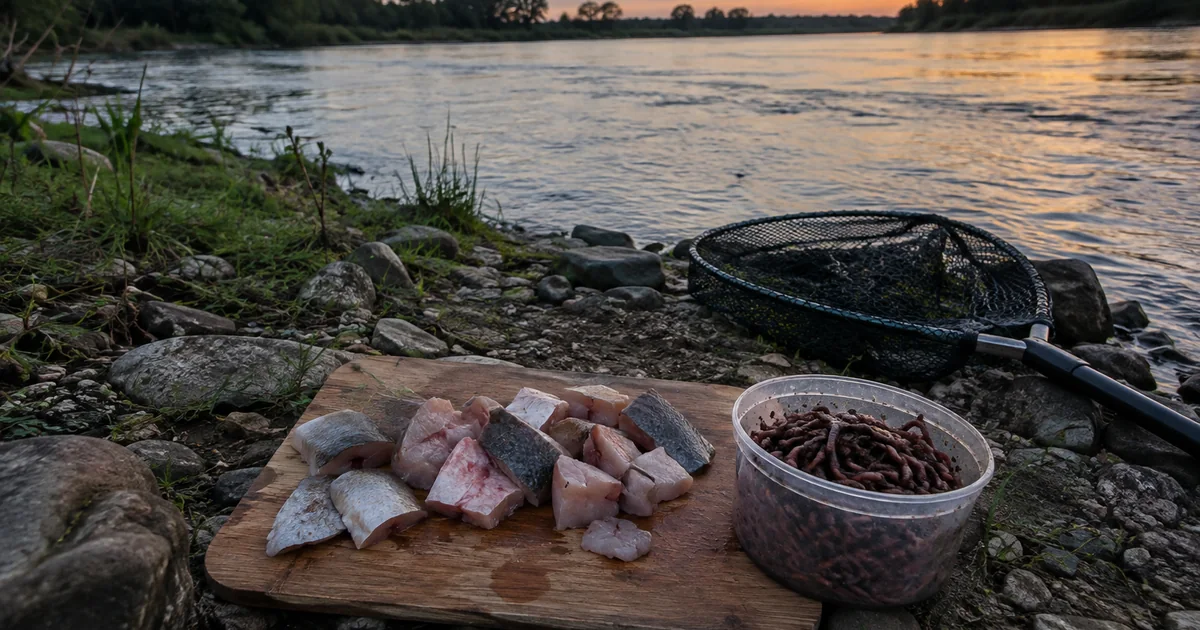
| Channel catfish | Insects, crustaceans, small fish, plus dead and decaying matter | Cut bait, chicken liver, stink and dough bait, nightcrawlers |
| Blue catfish | Baitfish schools, especially gizzard and threadfin shad | Fresh cut shad or skipjack herring |
| Flathead catfish | Live fish, crawfish and other live prey | Live bait, almost exclusively |
| Bullhead catfish | Almost anything small and edible | Worms, small cut bait, a small dab of stink bait |
Those four lines explain most blank days. A cooler of stink bait in flathead water is a wasted trip, and so is a worm on a 6/0 hook in a reservoir full of shad-eating blues.
Channel Cats Eat Across the Whole Menu
The channel cat is the generalist of the family and the most scent-driven of the big three. Its diet runs from insect larvae and crawfish up through small fish, and it will feed on dead and decaying material that other predators ignore. That last point is the one most anglers underuse: a channel cat is not looking for a healthy, lively meal. It is looking for a strong smell coming from something it can swallow.
Practically, that opens the widest bait list of any catfish. Cut chunks, a whole chicken liver, a gob of nightcrawlers, a paste bait on a sponge hook, all of it is inside the natural diet of a channel cat. In warm still water, above about 75°F, the paste baits come into their own, because there is no current to carry the scent away before it builds into a cloud.
Blue Cats Eat Shad, So They Follow Shad
Blue catfish are the baitfish specialists. They are mobile, they stay with the schools, and they will sit in current fast enough that other catfish avoid it, picking off bait that comes through the turbulence disoriented. Shad is their main natural forage, which is the whole reason fresh cut shad is the standard bait for them.
The useful consequence is about location, not bait. Find the bait and you have found the blue cats. Nervous, scattering minnows at the surface, a bait cloud on the sonar, or shad stacked below a dam all mean more than a textbook-looking piece of structure with nothing living around it. For the spots that funnel bait past fish on moving water, see where catfish hold in a river.
Flatheads Eat Live Prey, and That Is Not Negotiable
The flathead is the predator of the group, built on a different plan from the other two. It eats live fish, live crawfish and other live prey, and it rarely takes cut bait or stink bait at all. It is solitary and territorial rather than social, it tucks into heavy wood and undercut banks through the day, and it comes out at night to ambush.
So the diet dictates everything: a lively bluegill, shiner or crawfish, where your state allows it, fished at night against the heaviest cover you can reach. A half-dead baitfish in the same spot sends out far less movement and vibration, which is exactly the signal a flathead is reading. Our guide on how to catch flathead catfish covers the live bait end in detail.
Bullheads and White Cats: Small Mouths, Same Logic
Bullheads top out around 2 lbs, occasionally 4 or 5. They are aggressive opportunists that will bite nearly anything, and they thrive in warm, muddy, low-oxygen ponds and slow creeks that bigger catfish avoid. Treat them as channel cats scaled down: a worm or a small piece of cut bait on a small hook, on the bottom, in calm water.
White catfish, mostly an Atlantic and Gulf coast species, behave like channel cats but rarely pass 3 or 4 lbs, and they eat and bite the same way. If you land a hybrid and cannot tell what you have, feed it like a channel cat and you will be close.
The Diet Shifts Through the Year
Water temperature, not the calendar, moves the menu. Catfish are at their most willing between 70 and 85°F and slow down sharply below 50°F.
| Season | Water temp | What they are feeding on | Bait that matches |
|---|---|---|---|
| Spring | 55-70°F | Heavy feeding ahead of the spawn, then a lull during it | Cut bait and live bait both |
| Summer | 70-85°F | Everything, with the action pushed into low light | All types, best season for stink and dough bait |
| Fall | 50-70°F falling | Baitfish, as shad concentrate and get easier to catch | Cut bait |
| Winter | Below 50°F | Short feeding windows in deep, stable water | Fresh cut bait |
One more seasonal source of food is easy to miss: runoff. Light to moderate rain washes worms, insects and organic debris into a river or lake, and that alone can switch feeding on. The slight stain that comes with it plays to a catfish’s advantage over the sight-feeders it competes with.
Why the Diet Decides the Bait, Not Your Taste
Catfish see poorly and taste extremely well. Taste buds cover the entire body, more than 100,000 of them, concentrated on the barbels, so a catfish reads the water chemically long before it sees anything. That is why bait choice is a question of what the fish is wired to detect, not what looks appetising to you, and why a scruffy bait that leaks scent beats a tidy one that does not.
It also explains the light taps you feel before a real bite. A catfish uses its barbels to check what its distance senses already found. Those taps are the fish confirming the meal, not committing to it.
Worked example: an October reservoir falling through 58F with shad on the move
Say you pull up on a reservoir in mid-October. Surface temperature reads 58°F and still dropping, and you can see shad dimpling over a secondary creek channel. Here is what the diet tells you to do.
- Falling water in the 50 to 70°F band is the fall feeding window. Catfish are loading up before the metabolic slowdown below 50°F.
- Shad are the food on the table, and they get easier to catch as the water cools. So cut bait is the choice, not stink bait.
- For channel cats in the 3 to 10 lb range, cut 1 to 2 inch chunks with skin left on. For a shot at a 20 lb-plus blue, use a whole 5 to 8 inch baitfish or a large cut section instead.
- Fish the transitional water the bait is using: the points and the secondary channel, not the deep summer holes and not the shallow spring flats.
- Cut at an angle and slit the skin side so the scent leaves the bait faster.
Same lake in late July, that same bait choice would be a second-best answer, because warm still water is when stink and dough baits reach their peak.
Match the Size of the Meal to the Fish You Want
- Under 3 lbs (bullheads, small channels): single worms, small cut pieces.
- 3 to 10 lbs (average channel cat): medium cut chunks, a whole chicken liver.
- 10 to 20 lbs (big channels, smaller blues): larger cut chunks or a whole small baitfish.
- 20 lbs and up (trophy blues and flatheads): a whole 5 to 8 inch baitfish, or a large cut section.
When you are hunting one big fish, resist the urge to hedge with several small baits. A large, fresh, well-presented offering outproduces a spread of scraps, because a big fish holding in an ambush spot will not spend energy on a mouthful that is not worth it.
That is the whole chain in one line: identify the species in your water, work out what it eats there this month, then size the bait to the fish you want. For the full comparison of every bait category, how to cut it and how to keep it on the hook, read the best catfish bait for each species. Once you know what catfish eat, the bait aisle stops being confusing.
Frequently Asked Questions
Do catfish eat live fish or dead fish?
Both, but not in equal measure and not by the same species. Channel and blue cats take dead cut bait readily, and channels will even feed on decaying organic matter. Flatheads are the exception: they hunt live prey and rarely touch cut bait or stink bait.
What do catfish eat in winter?
Below about 50°F their metabolism slows hard and they feed in short windows instead of continuously, holding in the deepest stable water. Fresh cut bait works best then, because cold slows the fermentation that makes stink bait effective while blood and oil keep doing their job.
Do catfish eat worms?
Yes. Nightcrawlers and worms are a classic food and a classic bait for channel cats and bullheads of every size. They are much less effective on trophy blues and on flatheads, which want a larger meal.
What do blue catfish eat?
Blue cats feed heavily on baitfish, shad above all, and they will follow a school a long way to stay with it. That is why fresh cut shad or skipjack herring is the standard blue cat bait and why finding the bait usually means finding the fish.
Do catfish eat insects and crawfish?
Channel cats eat insects and crustaceans along with small fish, and bullheads will take almost anything small. Live crawfish are a natural staple in rocky rivers and creeks, and they catch both flatheads and channel cats there.
Tight lines,
— David