Catfish Rigs: The 5 Setups and When to Use Each
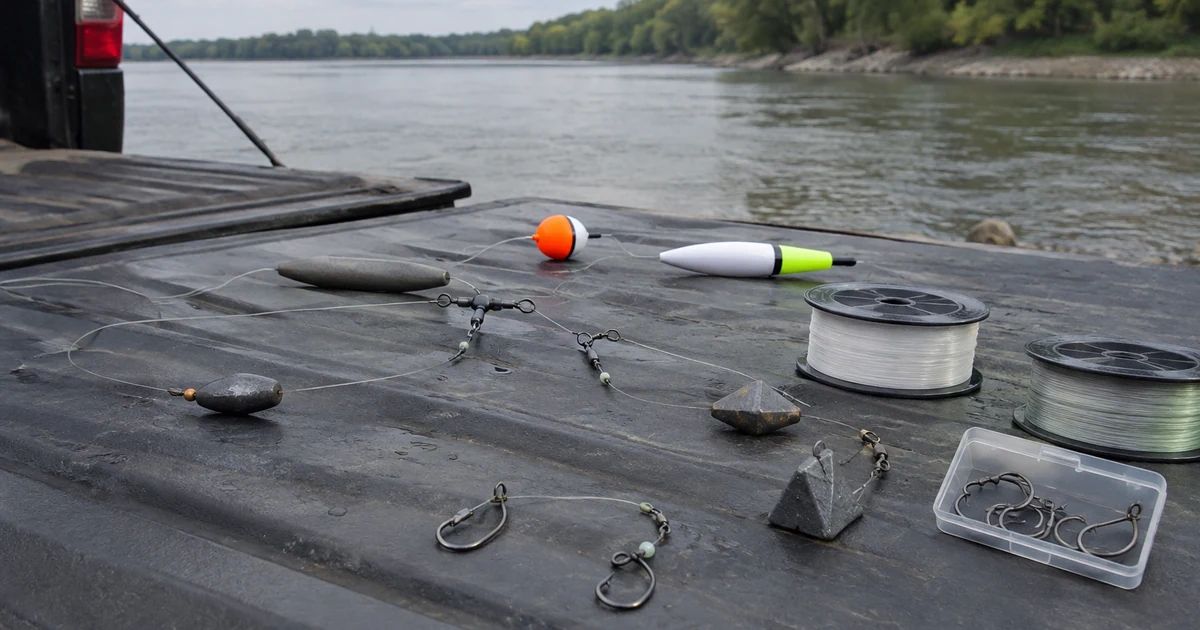
You don’t need a tackle box full of catfish rigs. Five setups cover well over 90% of the situations you’ll ever face: the slip sinker rig for everyday fishing, the three-way for strong current, the slip float for suspended fish and snags, the paternoster for testing baits, and jugs or limb lines for passive coverage where they’re legal. Here’s how each one is built and when to tie it on, as part of our complete catfish fishing system.
Catfish Fishing Mastery: the complete system this article comes from, as an instant PDF. Get the guide — $17
Quick Pick: Which Rig for Which Spot
| Rig | Current | Bottom | Best bait | Use it when |
|---|---|---|---|---|
| Slip sinker | Light to moderate | Any | Cut bait, liver, stink bait | You’re unsure or fishing in general |
| Three-way swivel | Strong | Rocky, snaggy | Cut bait | Fast rivers and tailwaters |
| Slip float | Any | Snags, debris | Live bait, cut bait | Fish are suspended over structure |
| Paternoster | Light | Clean | A mix of baits | You want to test several baits |
| Jug or limb line | Varies | Varies | Cut or live bait | Passive coverage, where legal |
1. The Slip Sinker Rig (Carolina Rig): Your Default
When in doubt, tie this one. It works from the bank or a boat, in rivers and lakes, in still water and moderate current.
- Run your main line through a sliding sinker. A no-roll or egg sinker of 1 to 3 oz, depending on current.
- Tie a barrel swivel below the sinker.
- Attach 12 to 24 inches of 20 to 40 lb mono or fluorocarbon leader.
- Tie on a circle hook and bait it.
Why it works: the line slides freely through the sinker, so a catfish can carry the bait off without feeling the weight right away. Fewer fish drop the bait, and you get cleaner hookups. The swivel keeps spinning cut bait from twisting your line. For the full walkthrough, see our step-by-step slip sinker rig guide.
2. The Three-Way Swivel Rig: Strong Current
- Tie the main line to one eye of a three-way swivel.
- On the second eye, tie a 4 to 8 inch dropper of slightly lighter line and clip a sinker to the end. A bank or bell sinker is the usual choice here.
- On the third eye, tie an 18 to 24 inch leader and your hook.
Why it works: the weight hangs on its own dropper instead of sliding on the main line, so it grips bottom in heavy current while the bait drifts a little above and away from it, right where catfish feed. The lighter dropper is on purpose. If the sinker wedges in rocks or wood, the dropper breaks first and you keep the rest of the rig.
Use it in fast rivers, tailwaters below dams, and over rocky or snaggy bottoms. It’s a staple when you chase blue catfish in the fall along channel edges and tailwaters.
3. The Slip Float Rig: Suspended Fish and Snags
- Thread a bobber stop and a bead onto the main line, then the slip float.
- Tie on a barrel swivel, then an 18 to 24 inch leader and hook.
- Pinch split shot just above the swivel if you need weight for casting and stability.
- Slide the bobber stop to set your depth.
This rig holds the bait at an exact depth above the bottom. Use it when fish hang over deep structure, around docks, over bottoms full of debris that would eat a bottom rig, or to drift a bait down a current seam at a set depth. It’s also a top choice for flatheads: a lively baitfish suspended just above heavy cover, as in our guide on how to catch flathead catfish.
4. The Paternoster (Spreader) Rig: Several Baits at Once
A paternoster puts two or three hook droppers above a single bottom weight. You can buy one pre-made or tie your own. Each bait sits at a slightly different height in the water.
Use it from the bank or a boat when you want to test different baits side by side to see what’s working, or simply want more hooks in the water where your state allows it. It fishes best in light current over a clean bottom.
5. Jug and Limb Lines: Passive Rigs (Check the Law First)
These rigs fish on their own while you watch, so one angler can cover many spots. They’re also heavily regulated. Some states ban them, others require tags, line limits, markings or a set check schedule. Read your state wildlife agency’s current rules before you set a single one.
Jug rig:
- Tie 4 to 8 feet of 30 to 50 lb line to the jug’s handle or a secure eyelet.
- Add a 1 to 3 oz sinker a few inches above the hook to hold the bait at a controlled depth.
- Bait with cut or live bait matched to your species.
- Spread jugs over a flat, channel edge or open water, far enough apart to keep an eye on each one. A jug that bobs oddly, rides low or moves against the wind has a fish.
New to it? Start with 6 to 10 jugs, not the 20 to 30 that experienced anglers run.
Limb line: pick a sturdy but flexible branch over good depth and structure. Tie 3 to 6 feet of heavy line to it so the limb’s flex absorbs the strike, add a sinker and a baited hook, and lower it in. Check it regularly. In many states, how often you check is part of the law.
Sinker Weights by Current
Use just enough weight to hold where you want the bait.
| Current | Sinker weight |
|---|---|
| Still water (pond, lake) | 1/2 to 1 oz |
| Light to moderate current | 1 to 2 oz |
| Strong current (big river, tailwater) | 3 to 6+ oz |
- No-roll sinkers: the best all-around pick for slip sinker rigs. The flat sides keep them from rolling in current, unlike a round egg.
- Bank or bell sinkers: cheap and effective on a three-way dropper, but they snag more in rocks.
- Pyramid sinkers: the flat sides dig into sand or mud and hold well in big-river current.
- Split shot: small weights to balance a float rig, not to anchor a bottom rig.
Target species shifts the numbers a little:
| Target | Hook | Still water | Current |
|---|---|---|---|
| Bullhead | #4 to #2 | 1/2 oz | 1 oz |
| Average channel cat | #1 to 2/0 | 1/2 to 1 oz | 1 to 2 oz |
| Large channel or small blue | 3/0 to 5/0 | 1 oz | 2 to 3 oz |
| Trophy blue | 6/0 to 8/0 | 1 to 2 oz | 3 to 6 oz |
| Flathead | 4/0 to 7/0, wide gap | 1 to 2 oz | 2 to 4 oz |
Hooks and Knots That Hold Every Rig Together
Make circle hooks your default on every rig, especially when the rod sits in a holder. They set themselves in the corner of the mouth and cut down on gut-hooked fish. When the rod loads up, reel steadily. Don’t jerk.
Four knots cover every connection:
- Palomar: hook to leader, strong and simple.
- Improved clinch: the alternative for heavy or stiff line that’s hard to double.
- Double uni: braid to leader.
- Albright: a slimmer braid-to-leader knot that passes through the guides more easily on a long cast.
Wet every knot before you cinch it, and pre-tie 4 or 5 of each rig at home. When you snag, you’re back in the water in seconds.
Frequently Asked Questions
Is a slip sinker rig the same as a Carolina rig?
Yes. Catfish anglers use both names for the same setup: a sliding sinker on the main line, a barrel swivel, a 12 to 24 inch leader and a hook. It’s the default rig whenever you’re unsure.
What size sinker do I need for catfish?
Use only enough to hold bottom: 1/2 to 1 oz in still water, 1 to 2 oz in light to moderate current, and 3 to 6 oz or more in big rivers and tailwaters.
Which rig is best for strong current?
The three-way swivel rig. The sinker hangs on its own short dropper, so it holds bottom while the bait rides slightly above it, and a snagged sinker breaks off without costing you the whole rig.
Are jug lines and limb lines legal?
It depends on your state and sometimes on the specific lake or river. Some states ban them, others require tags, line limits or set check intervals. Check your state wildlife agency’s current rules before you set one.
Tight lines,
— David