
Fall Crappie Fishing: Find the Bait, Find the Fish
Fall is the most underrated crappie season in America. The spring crowds are gone, the fish are feeding hard ahead of winter, and the big females are at their heaviest of the year. The catch is that fall crappie move, and they move fast. Anglers who fish last month’s spots come home talking about a slow fall. Anglers who follow one simple rule fill the cooler. This is the fall section of our complete crappie fishing system, and the rule is in the title: find the bait, find the fish.
Crappie Fishing Mastery: the complete system this article comes from, as an instant PDF. Get the guide — $17
What Happens to the Lake in Fall
Fall reverses spring, in fast-forward. As the surface water cools, the summer thermocline breaks down and the lake mixes top to bottom. That’s the turnover. For a week or two the water can look off-color and even smell a little, and the fishing gets tough. You just ride it out.
Then the whole lake is re-oxygenated, and crappie are free to roam. They follow the huge schools of young-of-year shad and minnows back toward the creeks and the mid-depth flats. Mid-depth cover loads up again: 8 to 15 foot brush, creek-channel edges, dock lines.
Fall Crappie by Water Temperature
Temperature, not the calendar, tells you where you are. Northern lakes run weeks ahead of southern ones in fall, so read the thermometer first:
- Falling through the 70s (often September): fish start to move. Look at creek mouths, points and the first flats. This is usually when the turnover funk hits.
- 60s and falling (often October): the heart of fall. Crappie are in the creek arms and on mid-depth flats at 8 to 15 feet, wherever the bait is.
- 50s and falling (often November): the creek arms empty out toward channel structure at 12 to 20 feet. Schools tighten and suspend. Fish mid-column, not the bottom. Move out a week early rather than a week late.
Below that, you’re into winter: deep basins, tight schools, and hardwater season in the north.
Find the Bait First
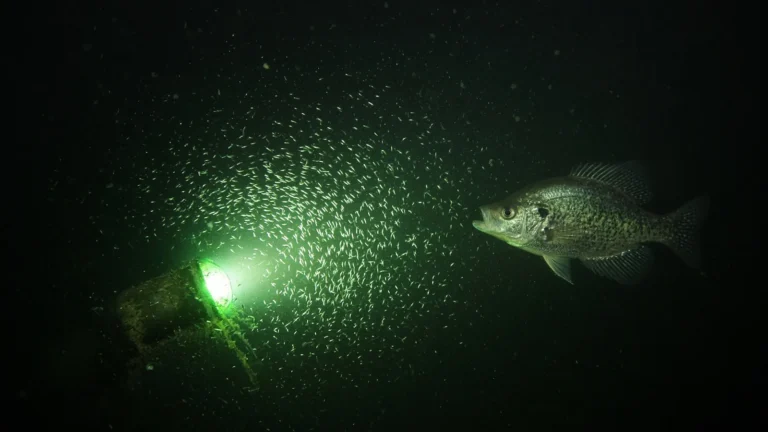
Crappie live where they eat, and in fall that is never more literal. In reservoirs, shad schools move constantly and the crappie move with them. So the first job of every fall trip is not casting. It’s finding bait.
- With electronics: idle the creek arms and watch the graph for bait clouds. A textbook brush pile with no bait nearby is off today, so trust the empty screen and keep moving. A cloud of bait with a few arcs under it in the middle of “nowhere” means stop. Nowhere just became somewhere.
- Without electronics: use your eyes. Dimpling minnows at the surface and birds working the water tell you where the bait is. Then fish the cover nearest to it.
Treat the bait as the real structure and everything else as furniture.
How to Fish Fall Crappie
Fall fish are aggressive and grouped, but they roam. So the approach has two gears: cover water until you find them, then slow down.
- Search fast. Cast and count down, or slow-troll jigs, along creek-arm channels, flats and cover near the bait. Count every fall so you know what depth you’re fishing.
- Convert the first bite into a depth. When you get bit, note the count. If a 1/16 oz jig on light line falls roughly a foot per second, a seven-count is about seven feet.
- Slow down on contact. Work that spot thoroughly: longer pauses, slower retrieve, the same depth. Where there’s one crappie, there are more.
- Carry the depth around the lake. Crappie hold at about the same depth lake-wide on a given day. Once you know it, fish that depth on every similar piece of cover before you try anything else.
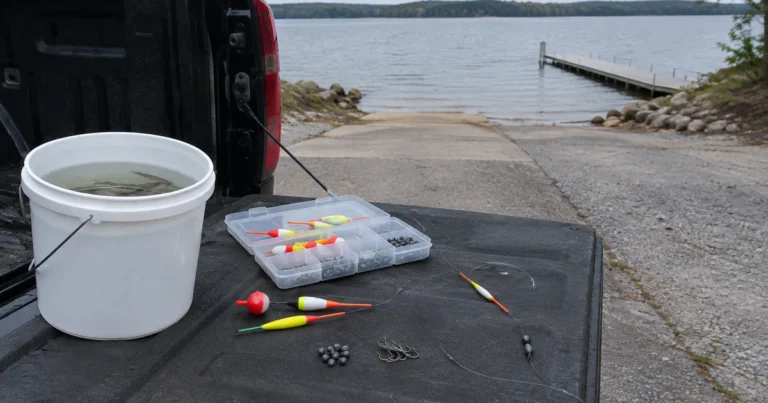
A slip bobber set to the productive depth is a deadly way to hold a jig or minnow beside cover once you’ve found the school, from a boat or from shore.
The Best Fall Spots
- Creek arms with channel bends near a bank. The bends are where migrating schools stop.
- Laydowns in creek arms. Work the deep end, the crown, first. That’s usually where the better fish sit.
- Mid-depth brush piles in the 8 to 15 foot band, near bait.
- Bridges. Pilings connect every depth, and the shaded side often out-fishes the sunny side.
- Dock lines in the creek arms. Dock shooting works well into fall on sunny days.
Fall is also a great season for shore anglers: the feeding migration brings schools back within casting range, especially at creek inlets and bank-side cover. Our bank fishing guide for crappie covers the walking version.
Timing: Fall Is the Forgiving Season
Fall has the most forgiving clock of the year. Crappie feed in stretches all day rather than in one dawn window, and afternoons are excellent as the flats warm. You don’t need to be on the water at sunrise to have a good day.
Watch the weather too. Three stable days beat one pretty day. A front that just passed pushes fish tighter to cover and a little deeper, so slow down and downsize. The day before a front is often the best bite of the week.
When the Fish “Disappear” in Fall
- Same spot, same depth, nothing. In fall they slide a foot or two every week. Start shallower than last time and work down.
- The whole creek arm died. The water dropped below what the shad tolerate. Move out to the first channel structure toward the main lake and fish mid-column.
- The shallow bite vanished overnight. Check the lake level. Falling water empties shallow cover fast.
- The lake looks off-color and smells. That’s turnover. Fish shorter trips and shallower for a week or two. After that comes some of the best fishing of the year.
Your Fall Game Plan
- Take the water temperature every trip and note which way it’s moving.
- Open a contour map and circle the channel bends in two creek arms, plus one bridge and one brushy point.
- Find the bait before you fish. No bait, no stop.
- Turn your first bite into a depth, then fish that depth everywhere.
Tight lines,
— David



2 Comments
Comments are closed.