Walleye Trolling Speed by Water Temperature
Walleye trolling speed is set by water temperature: crankbaits run 1.0 to 1.5 mph under 50°F, 1.5 to 2.0 mph from 50 to 65°F, and 2.0 to 2.8 mph above 65°F, with crawler harnesses roughly half a mile an hour slower in every band. Those are GPS ground speeds, not engine feel, and they are the first dial you set on any pass in our complete walleye fishing system.
Walleye Fishing Mastery: the complete system this article comes from, as an instant PDF. Get the guide — $17
The Speed Table
Read the thermometer, pick the row, start in the middle of the range. Then let the fish move you inside it.
| Water temp | Crankbaits | Harnesses | What to pull, and how deep |
|---|---|---|---|
| Under 50°F | 1.0-1.5 mph | 0.6-1.0 mph | Slender stickbaits over shallow rock and breakline lips, 2-10 ft; minnow rigs do most of the live bait work this cold |
| 50-65°F | 1.5-2.0 mph | 0.8-1.2 mph | Stickbaits and shallow divers on weedlines, points and sand flats, 6-14 ft |
| 65°F and up | 2.0-2.8 mph | 1.0-1.5 mph | Deep divers and boards on 15-35 ft structure; leadcore or snap weights for fish suspended 15-30 ft down over the basin |
Why Temperature Sets the Speed
Cold water slows a walleye down, warm water speeds it up. Under 42°F, slow is a speed and stopped is a tactic. At 72°F a walleye’s metabolism is at its peak and it eats more, not less, which is why a bait ripped past an active fish in July out-fishes a finesse bait soaked in front of a neutral one.
That has a practical consequence most anglers get backwards. Fish fast until the walleye tell you to slow down, not the other way around. A reaction speed finds the aggressive fish quickly; once you have found them you can slow down and clean up the neutral ones. Running one speed all year is one of the ten classic walleye mistakes, and the fix costs nothing but a glance at a thermometer.
Harnesses Run Slower Than Cranks
A crankbait wants speed to work. A spinner blade ahead of a nightcrawler wants just enough to turn. That is why every temperature band has two numbers.
- Crawler harness behind a bottom bouncer: 0.8 to 1.5 mph, with 1.0 mph as the everyday setting. The blade should just barely spin at your slowest.
- Walking sinker rigs with a minnow, leech or half crawler: 0.3 to 0.8 mph. Slower than trolling. This is the speed for neutral fish and marks that ignore a jig.
- Stickbaits from a small boat or a kayak: 1.5 to 2.0 mph along a shoreline break at paddle or tiller pace is a legitimate way to troll without a big rig.
Speed Is Also a Depth Control
Change the mph and you change where your baits run, which is why speed and depth have to be set together.
- Crankbaits: every bait has a dive curve based on line out and line diameter. The working shortcut for deep divers is about 1 foot of depth per 5 to 6 feet of line out on 10 lb mono, up to the bait’s maximum. A printed chart or an app gets you inside 2 feet.
- Leadcore: sinks roughly 5 feet per color at 2 mph, so the speed number is part of the depth math.
- Snap weights: clip-on weights, commonly 2 to 3 oz on the 50/50 pattern, 50 feet to the weight and 50 feet to the bait.
- Bottom bouncers: 1 oz per 10 feet of depth at 1.0 mph, with the wire ticking bottom on a 45-degree line angle.
One rule beats all of it: run the baits just above the fish. Marks at 18 feet over 30 means baits at 16 to 18, never 20. Walleye look and feed upward.
Worked example: a 52F lake in late May, marks at 16 feet
Say the surface is 52°F in late May and your sonar shows fish at 16 feet over a 28-foot breakline. Here is how the numbers fall into place:
- Band: 50 to 65°F, so crankbaits run 1.5 to 2.0 mph. Start at 1.7 mph on the GPS.
- Depth target: 14 to 16 feet, not 18. Running just above the fish always beats running below them.
- Line out: a deep diver reaches roughly 1 foot of depth per 5 to 6 feet of line out on 10 lb mono, so 80 to 90 feet back puts you in the window. A dive chart gets you inside 2 feet.
- First fish: write down the line counter number, the lure and the speed, then set the other rods to the same number.
- Refine: run S-turns. If the outside rods keep firing, push to 1.9 mph. If the inside rods do, drop to 1.5.
Same lake at 70°F in July and the same spread wants 2.0 to 2.8 mph. Same lake at 44°F in November and it wants 1.0 to 1.5, with a bigger bait.
Let the Fish Set the Final Decimal
The table gets you in the right half mile an hour. S-turns find the exact number. When you swing the boat, the inside baits slow and fall while the outside baits speed up and rise. If the outside rods keep firing, speed up. If the inside rods do, slow down. That is the fish talking, and it costs you nothing to listen.
Fish that tap without hooking up are telling you something about speed too: drop 0.3 mph and add a pause and surge with S-turns. A bait that briefly dies is what converts a follower.
How to Hold a Speed
You cannot repeat a speed you are not measuring. Four habits do the work:
- Watch GPS ground speed, not the tachometer. Wind and current move your bait even when the motor does not change.
- Use a drift sock, motor trim and short bursts to hold the number when the wind pushes you off it.
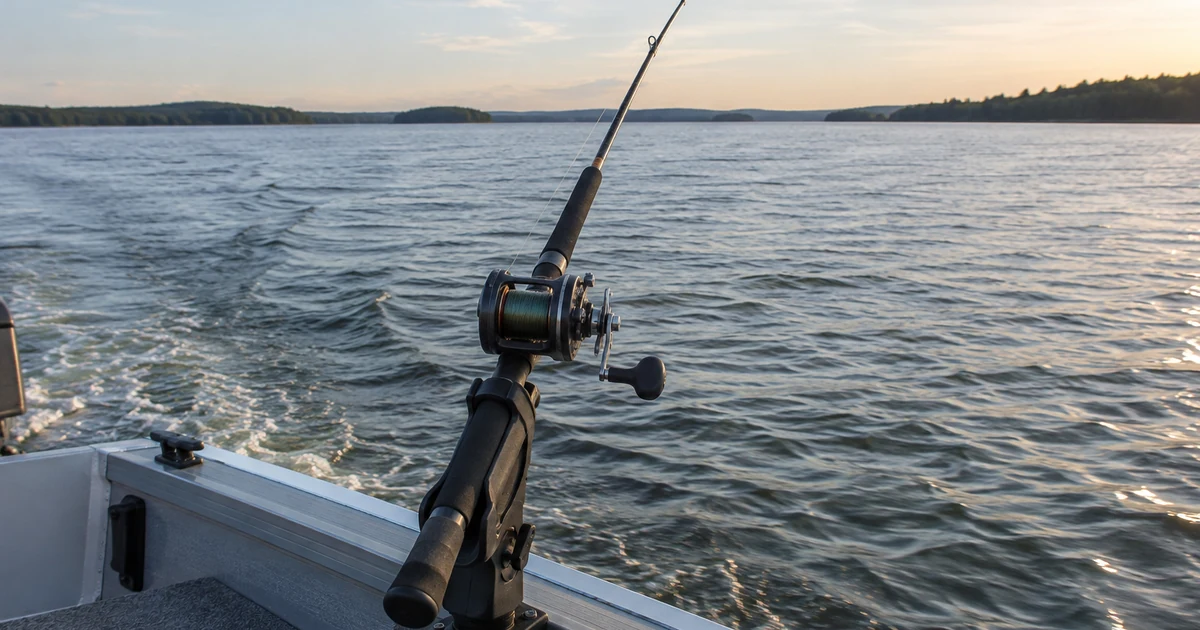
- Run a line-counter reel. When a fish hits at 87 feet back, every other rod goes to 87 feet. Without a counter you are guessing, and guessing does not repeat.
- Troll with a soft rod. A moderate action absorbs the surge of a fish hitting behind a moving boat; a stiff rod tears the hook out of a soft walleye mouth at the net.
Wind is where speed discipline really shows. A chop is a feeding bell and you want to fish the windward side, but when you cannot hold 0.8 mph you cannot fish properly either. Heavier bouncers, a drift sock, or tucking behind the same structure are the answers; the walleye chop covers the rest.
What Else Moves the Number
- A cold front. Bluebird sky and a north wind mean deeper, slower, smaller, tighter. Drop to rigging speeds or stop moving altogether, as covered in walleye after a cold front.
- Falling water temperature in autumn. As the water cools through the 40s you come back to 0.5 mph rigging and bigger baits, with the day’s fishing concentrated into the dusk window. That is the whole logic of the fall trophy window.
- Sudden muddy water. Bites go to vibration and silhouette: slower speeds, rattles and blades, tighter to structure.
- Clearing water after runoff. Fish slide deeper day by day, so add depth before you add speed.
Record Every Fish
Trolling is not dragging lures and hoping. The anglers who catch three times as many write down the line counter number, the lure, the speed and the GPS spot on every single strike, then copy that setting across the spread. One fish is luck. The second on a copied setting is a pattern. The rest are a limit.
So keep it simple on the water: take the surface temperature, pick the row, start in the middle, split the difference between cranks and harnesses, and let S-turns and the line counter sharpen it from there. Set that way, walleye trolling speed stops being a guess and becomes the one dial you can trust all season.
Frequently Asked Questions
How fast should you troll for walleye?
By water temperature. Crankbaits run 1.0 to 1.5 mph under 50°F, 1.5 to 2.0 mph from 50 to 65°F, and 2.0 to 2.8 mph above 65°F. Crawler harnesses run slower in every band: 0.6 to 1.0, 0.8 to 1.2, and 1.0 to 1.5 mph.
Is 2 mph too fast for walleye?
Not in warm water. Above 65°F, 2.0 to 2.8 mph is the normal crankbait range and aggressive fish will run a bait down. Under 50°F it is too fast for most days, and you want 1.0 to 1.5 mph.
What speed should I pull a crawler harness?
Inside 0.8 to 1.5 mph, with 1.0 mph as the all-purpose setting. The blade should just barely turn at your slowest speed. Match the bouncer to depth at 1 oz per 10 feet and keep the line angle near 45 degrees.
Should I troll slower after a cold front?
Yes, and deeper. Behind a front the order is deeper, slower, smaller, tighter to cover. Drop to rigging speeds of 0.3 to 0.8 mph, or stop moving and hold a bait still. The dusk window survives a front even when the rest of the day does not.
Does GPS speed matter more than engine speed?
Yes. Only ground speed tells you how fast the bait is really moving, and wind or current can change it by half a mile an hour with nothing changed at the motor.
Tight lines,
— David