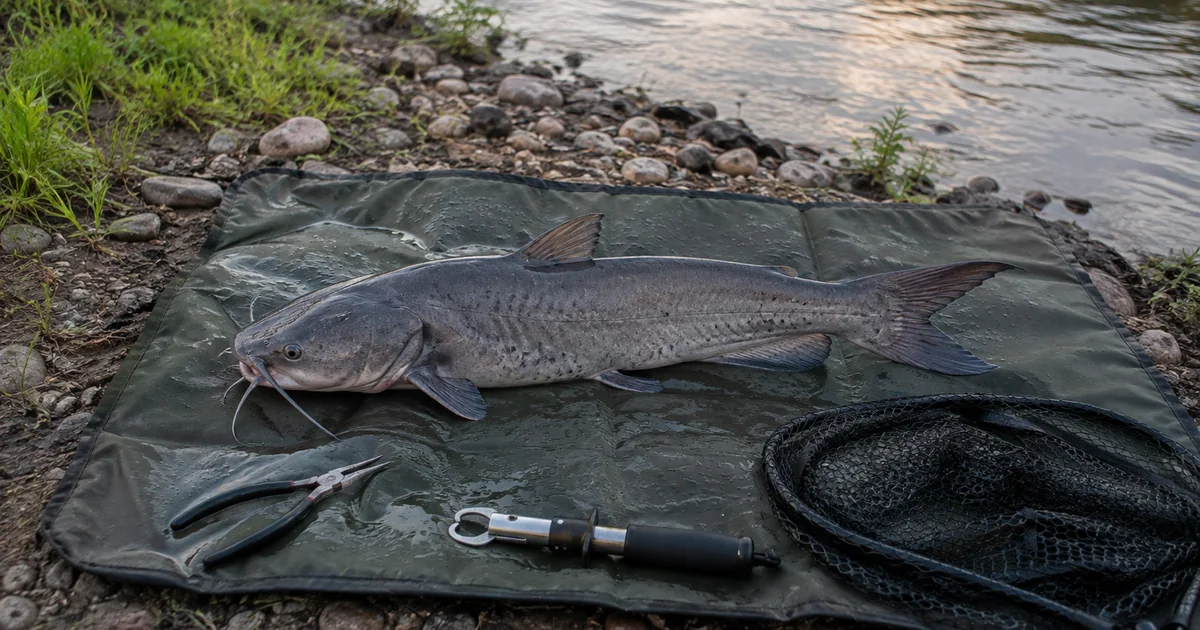
How to Hold a Catfish Safely, by Size and Species
To hold a catfish safely, come in from above and a little behind the head, wrap your hand across the body right behind the gill plates, and keep every finger clear of the two pectoral spines sitting there, one per side. That one grip covers most fish you will land. Past about 10 lbs it stops being a lift and becomes a two-hand job, and past 25 lbs it becomes a cradle, which is where our complete catfish fishing system gets specific about size.

Catfish Fishing Mastery: the complete system this article comes from, as an instant PDF. Get the guide — $17
The Spines Are the Whole Problem
A catfish has hardened, sharp spines at the leading edge of each pectoral fin and on the dorsal fin. Grab the fish wrong and one of them goes into your hand, and it is a genuine puncture rather than a scratch. The pectoral pair is what catches people out, because they sit exactly where an instinctive grab lands: just behind the gill plates, one on each side.
The fish is not aiming them at you. A catfish simply thrashes when it is handled, and a careless hand finds a spine on its own. Everything below is about putting your fingers where those three points cannot reach.
The Standard Grip, Step by Step
- Wet your hands first, along with any mat or towel you are going to lay the fish on.
- Approach from above and slightly behind the head. Coming in from the front or the side walks your fingers straight into the pectoral spines.
- Wrap your hand across the body right behind the gill plates, with the pectoral fins outside your grip rather than under your palm.
- Add your other hand under the belly on anything with real weight to it, instead of carrying the whole fish on one head grip.
- Keep it horizontal. A fish held level is supported. A fish hanging vertically is carrying its own weight on its jaw.
If you would rather not put a hand near the head at all, a mechanical lip-gripping tool controls the head while you work, and it is worth having if you fish alone for bigger fish.
By Size: What Changes
| Fish size and species | Recommended hold | What to avoid |
|---|---|---|
| Bullheads, small channel cats, under 10 lbs | Lift by hand, firm grip behind the head, fingers clear of the pectoral spines | Grabbing from the front or scooping the fish up with a hand under the pectoral fins |
| Channel cats and smaller blues, 10 to 25 lbs | Net it first, then one hand behind the head and one under the belly | A one-hand head grip, which strains the spine and the organs at that weight |
| Blues and flatheads, 25 lbs and up | A floating padded cradle that carries the whole body, with a lip-grip tool for the head | Hanging it vertically by the jaw, or lifting a heavy fish on the net frame alone |
| Any fish going back | Wet hands and wet mat, horizontal, 30 to 60 seconds out of the water | Dry hands, dry grass or concrete, and long photo sessions |
Get It Out of the Water Properly First
Most handling injuries, to you and to the fish, happen in the last few seconds of the fight. Have the net or the cradle open and within reach before the fish arrives, not after. Fish under about 10 lbs you can simply lift by hand with the grip above. From 10 to 25 lbs, use a wide-hoop net on a stiff frame, and scoop in from the front, head first, instead of chasing the tail. Above 25 lbs, a floating padded cradle spreads the load across the whole body and avoids the internal damage a heavy fish can take when it is lifted by a net bag or one hand.
And stay patient right at the end. Anglers sense the fight is over, lean on the fish, and lose it on a last burst three feet from the bank. For the rest of the landing sequence, see how to catch catfish.
Taking the Hook Out Without Putting a Hand Inside
A circle-hooked catfish is usually pinned in the corner of the mouth, easy to see and easy to reach. Grip the hook shank with needle-nose pliers and back it out along the angle it went in. For anything set deeper, use a long-handled hook remover or forceps so your fingers stay out of the mouth. The inner tooth pads are not dangerous like the spines, but they will abrade your skin with repeated contact.
If a hook is stuck fast and you are releasing the fish, snip the line right at the hook and let the fish go with it still in. Most hooks that are not stainless will corrode and work free in time, and that is a better outcome than two minutes of forcing. Blunt or chewed hooks are one of the six classic mistakes in our catfish troubleshooting guide.
If a Spine Does Get You
It happens. Catfish spines in U.S. waters are painful rather than seriously dangerous. Clean the wound, keep an eye on it over the next day or two for unusual swelling or any sign of infection, and keep basic first aid supplies in the tackle bag so you are not improvising on the bank. Anything beyond that is a question for a medical professional, not a fishing guide.
The far better plan is not getting stuck in the first place: pliers, a mat and a light within reach before the first cast, which is half of what makes a good station in night bank fishing for catfish.
Worked example: a 20 lb blue cat landed alone on a steep bank at night
Say a 20 lb blue cat comes in on a steep bank, after dark, and you are fishing alone. The size band puts you squarely in net territory, and the sequence matters more than strength.
- The net is already open and within arm’s reach before the fish is close, not after. Fumbling for it in the last few seconds is how fish of that size get lost.
- Scoop from in front, head first, rather than chasing the tail.
- Wet the mat and your hands, then lay the fish down. Mucus is its protection against infection, and dry hands strip more of it off.
- One hand just behind the head and gill area, the other under the belly. At 20 lbs, a one-hand head grip puts real strain on the spine and the organs.
- Pliers, photo, back in the water inside 30 to 60 seconds. Hold it facing into the current until it pulls away under its own power.
The same fish at 8 lbs you lift by hand. At 30 lbs you want a cradle, not a net.
Putting It Back So It Swims Off
- Keep it short. Thirty to sixty seconds out of the water for hook and photo, less on a big fish after a long fight.
- Support it horizontally, never by the jaw alone on a heavy fish.
- Revive it. Cradle it in the water with its head into whatever current there is, and wait until it pulls away under its own power.
- Pick the release spot. Don’t turn a tired fish loose in shallow, hot or oxygen-poor water if better water is a few steps away.
That matters most on the biggest fish. A trophy blue or flathead took many years to reach that size, and a photo with proper support followed by a careful release keeps it in the system for someone else. Learn how to hold a catfish properly once, and both your hands and the fish come out of every trip fine.
Frequently Asked Questions
Where do you grab a catfish?
Just behind the head and the gill area, coming in from above and slightly behind. Your thumb and fingers wrap the body there, clear of the pectoral spines that sit just behind the gills on each side. On anything heavy, add your other hand under the belly.
Do catfish sting, and is it dangerous?
Catfish have hardened spines on the pectoral fins and the dorsal fin that can deliver a painful puncture. A pectoral jab can feel mildly venomous, but for the species you meet in U.S. waters it is unpleasant rather than dangerous. Clean the wound and watch it for unusual swelling or signs of infection.
Can you hold a big catfish up by its mouth?
Not by the jaw alone. A large fish hanging vertically on its own weight can damage its jaw and its internal organs. Support it horizontally with a hand under the belly, or use a floating padded cradle, and let a lip-gripping tool control the head while you work the hook out.
Should you wet your hands before handling a catfish?
Yes, and the mat or towel too. A catfish carries a protective mucus layer that helps keep infection out, and dry hands or dry grass strip away more of it than wet ones do. It costs nothing and it matters most on fish you intend to release.
How long can a catfish stay out of the water?
Keep handling for the hook and the photo under 30 to 60 seconds where you can, and less on a big fish that has already had a long fight. After a hard fight, hold it in the water facing any current until it swims off on its own strength.
Tight lines,
— David